
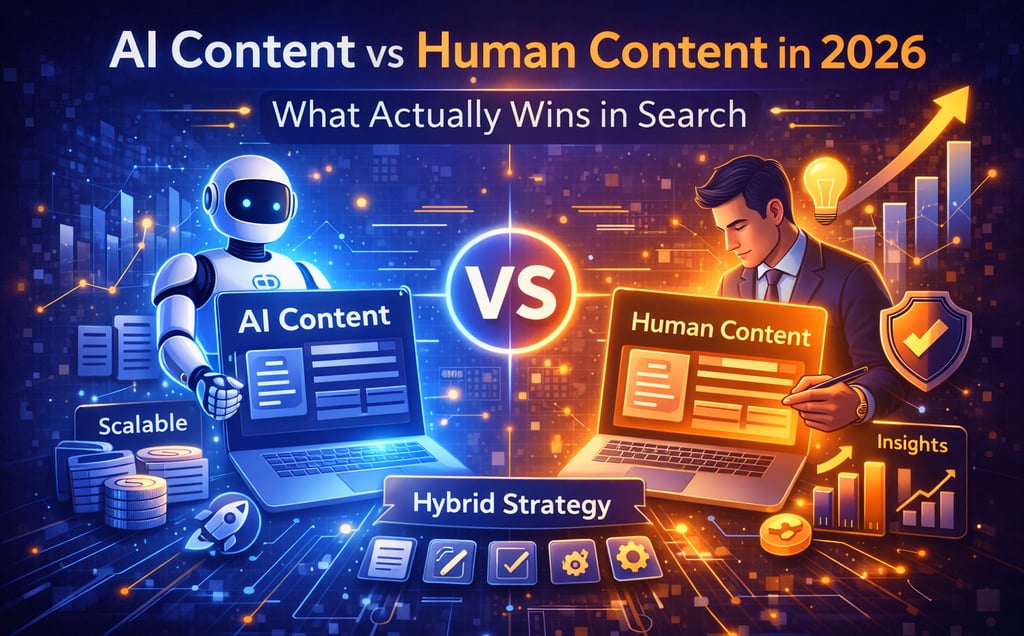
AI Content vs Human Content in 2026: What Actually Wins in Search
Explore how AI-generated and human-written content compare in 2026 and learn why the most successful SEO strategies combine both for scalable, high-quality search performance.
3/9/20263 min read
The rise of AI writing tools has changed how content is created.
Businesses can now generate articles, product descriptions, landing pages, and entire knowledge bases in minutes. What once required teams of writers can now be produced at scale with a few prompts.
This shift has created one of the most debated questions in modern SEO:
Should businesses rely on AI content, or does human-written content still perform better?
In 2026, the answer is no longer about choosing one over the other. Search engines are not evaluating whether content was written by AI or by humans. Instead, they evaluate whether the content is useful, trustworthy, and aligned with user intent.
The real question is not AI versus human content.
It is whether your content provides real value.
The Rise of AI-Generated Content
AI writing tools have dramatically accelerated content production. Companies can generate large volumes of content quickly, allowing them to scale blog posts, product descriptions, FAQs, and landing pages faster than ever before.
This scalability has made AI particularly attractive for businesses managing large websites or content libraries.
AI tools are now capable of summarizing information, organizing topics, and producing structured content that aligns with common search queries.
However, speed alone does not guarantee visibility in search results.
Search engines still prioritize quality, relevance, and credibility.
What Search Engines Actually Care About
Search engines do not rank content based on whether it was written by a human or generated by AI.
Instead, they evaluate signals such as:
Content usefulness and clarity.
Depth of topic coverage.
Trustworthiness of the source.
User engagement and satisfaction.
If AI-generated content is shallow, repetitive, or lacks real insight, it is unlikely to perform well.
But if AI is used to help produce structured, informative content that genuinely helps users, it can absolutely rank.
Search engines care about outcomes, not the writing method.
Where AI Content Works Best
AI content performs particularly well in areas where information is structured and repetitive.
Examples include product descriptions, FAQ sections, and programmatic content pages that follow a consistent template.
AI can also assist with summarizing research, generating outlines, and expanding topic coverage across large content ecosystems.
When used correctly, AI allows businesses to cover more search demand efficiently without sacrificing clarity.
However, these types of content usually rely on data and structure rather than deep analysis or personal insight.
Where Human Expertise Still Wins
Human-written content remains essential for areas that require experience, interpretation, or originality.
Thought leadership articles, industry analysis, and opinion pieces benefit from human expertise that AI cannot replicate.
Real-world insights, case studies, and strategic perspectives add credibility and uniqueness to content.
Search engines increasingly reward expertise and authenticity, especially in topics where trust and authority matter.
Human perspective gives content a depth that purely automated writing often lacks.
The Hybrid Content Model
The most effective strategy in 2026 is not AI-only or human-only content.
It is a hybrid approach.
AI assists with research, structure, and initial drafts. Humans provide editing, insights, and strategic direction.
This combination allows businesses to scale content production while maintaining quality and authority.
AI becomes a productivity tool rather than a replacement for expertise.
Structuring AI-Assisted Content for SEO
To ensure AI-assisted content performs well in search results, it must be structured carefully.
Content should focus on answering real user questions clearly and concisely. Information should be organized logically with headings, summaries, and supporting details.
Topical authority also matters. Instead of publishing isolated articles, businesses should build interconnected content clusters around core topics.
Internal linking helps search engines understand relationships between pages and strengthens the overall authority of the website.
Editing and fact-checking remain critical. AI-generated drafts should always be reviewed to ensure accuracy and clarity.
The Strategic Advantage
AI has fundamentally changed the economics of content production.
Businesses that combine AI efficiency with human expertise can produce high-quality content at scale while maintaining strong authority signals.
This allows them to cover more search demand, respond faster to new topics, and build larger content ecosystems.
Over time, this creates a powerful advantage in competitive search environments.
Final Thoughts
The future of content is not AI versus humans.
It is collaboration.
AI helps scale production and organize information. Humans bring expertise, judgment, and originality.
Search engines reward content that genuinely helps users, regardless of how it was created.
In 2026, the businesses that win in search will not simply produce more content.
They will produce smarter content — combining the speed of AI with the insight of human expertise.