
AI Search vs Google Search: How SEO Is Changing Forever
Discover how AI search is changing SEO, what it means for your rankings, and how to stay visible in an answer-driven search landscape.
4/8/20262 min read
Search is changing.
For years, Google dominated how users discovered information.
But in 2026, a new shift is happening:
👉 AI-powered search is redefining how people find answers.
This doesn’t mean Google is disappearing.
It means the rules of SEO are evolving.
What Is Traditional Google Search?
Google search is based on:
Crawling web pages
Indexing content
Ranking results based on relevance and authority
Users search → Google shows links → users click.
This model has worked for decades.
What Is AI Search?
AI search works differently.
Instead of showing a list of links, it:
Understands the question
Synthesizes information
Provides direct answers
Examples include:
AI-powered search engines
Chat-based search assistants
Generative answer systems
Users now get answers without needing to visit multiple websites.
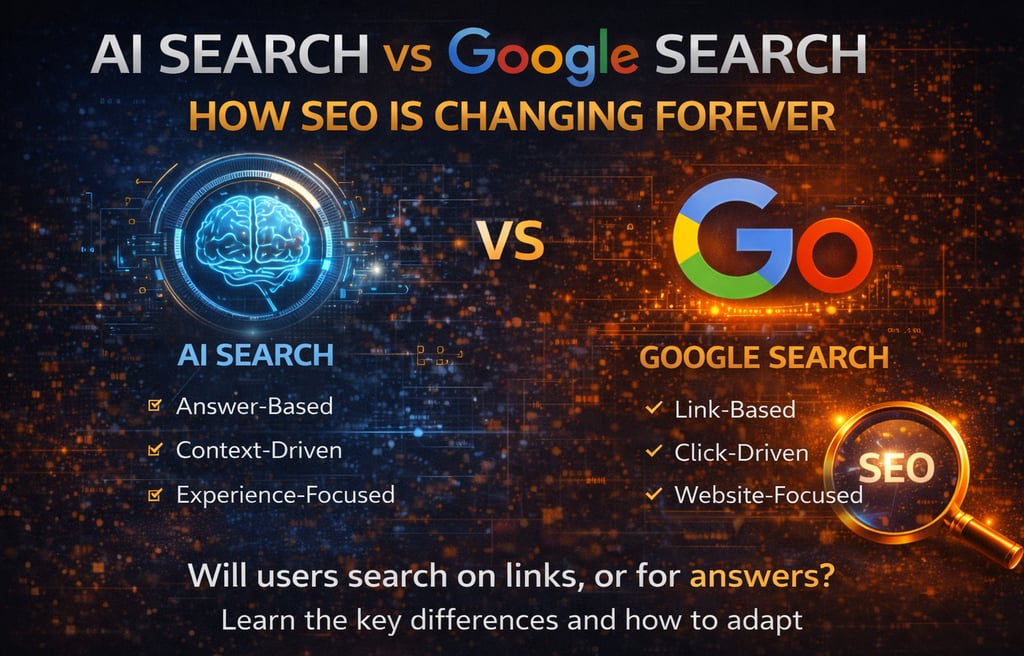
The Key Difference
Google Search
Link-based
Click-driven
Website-focused
AI Search
Answer-based
Context-driven
Experience-focused
Why This Changes Everything
This shift impacts SEO in a fundamental way.
Previously, success meant:
👉 Ranking on page one
Now, success means:
👉 Being part of the answer
If your content is not referenced, summarized, or trusted by AI systems—you lose visibility.
The Rise of Zero-Click Search
Users are increasingly getting answers directly on search platforms.
This means:
Fewer clicks to websites
More importance on visibility within answers
Higher competition for trusted sources
SEO is no longer just about traffic.
It’s about presence.
What AI Search Prioritizes
AI systems look for:
Trustworthy Sources
Content must come from credible, authoritative websites.
Clear, Structured Information
Well-organized content is easier for AI to understand and use.
Depth and Context
Surface-level content is less likely to be selected.
Entity Recognition
AI connects topics, brands, and concepts—not just keywords.
How SEO Strategies Must Evolve
To stay competitive, SEO must adapt.
Focus on Topical Authority
Build deep expertise within a niche.
Optimize for Answers
Create content that directly answers user queries.
Strengthen Brand Signals
AI systems favor recognized and trusted brands.
Improve Content Structure
Use clear headings, concise explanations, and logical flow.
Build Multi-Platform Presence
Visibility beyond your website is becoming critical.
The New SEO Goal
The goal is no longer just:
👉 “Rank #1 on Google”
It is:
👉 “Be the source AI trusts and uses.”
Google’s Role in This Shift
Google itself is integrating AI into search.
This means:
Traditional SEO and AI SEO are merging
Ranking factors are evolving
Content expectations are increasing
SEO is not disappearing.
It is transforming.
The Strategic Advantage
Businesses that adapt early gain a significant advantage.
They:
Build authority faster
Get referenced by AI systems
Stay ahead of competitors
Those who rely only on old SEO methods risk falling behind.
Final Thoughts
AI search is not replacing Google.
It is redefining how search works.
In 2026, the winners are not those who chase rankings.
They are those who:
👉 Build trust
👉 Create high-quality content
👉 Become authoritative sources
Because the future of SEO is not just about being found.
It’s about being chosen.