
Content Depth vs Content Volume in 2026: What Actually Wins in Search
Discover why content depth is outperforming content volume in 2026 and how comprehensive, high-value content builds stronger rankings and topical authority.
3/10/20263 min read

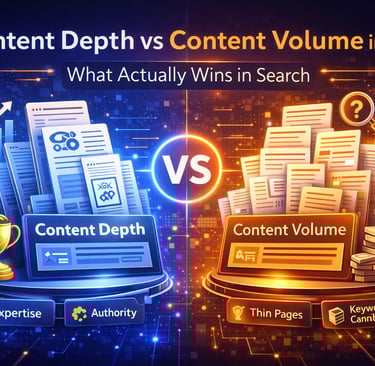
For many years, SEO strategies focused on one simple idea: publish more content.
The logic seemed straightforward. The more pages a website had, the more keywords it could target and the more opportunities it had to appear in search results.
But search engines have evolved.
In 2026, modern search systems evaluate not just how much content a website publishes, but how deeply that content explores a topic. As a result, many websites producing large amounts of shallow articles struggle to build lasting visibility.
Today, the real question is not how much content you publish, but how valuable and comprehensive that content is.
The Era of Content Volume
During the early years of SEO, content volume often worked as a growth strategy.
Businesses published hundreds or even thousands of blog posts targeting individual keywords. Each article might cover a slightly different variation of the same topic.
This approach allowed websites to capture traffic from many search queries.
However, it also created large amounts of repetitive and low-value content.
As search engines improved their understanding of topics and context, this strategy began losing effectiveness.
Why Content Depth Matters More Today
Search engines are now far better at evaluating the quality and completeness of information.
Modern algorithms analyze how well a page answers a user's question and how thoroughly a website covers a topic.
Instead of ranking pages simply because they contain certain keywords, search engines evaluate whether the content demonstrates expertise and authority.
Websites that provide comprehensive explanations, structured insights, and clear guidance tend to perform better than sites that publish many short, superficial articles.
Depth creates trust, and trust improves rankings.
Topical Authority and Content Depth
Content depth also contributes to topical authority.
When a website consistently publishes detailed content about a specific subject, search engines begin to associate that website with expertise in that area.
This association helps the website rank not only for one keyword but for many related queries.
For example, a site that deeply covers modern SEO topics—technical SEO, AI search, entity optimization, and forecasting—signals a stronger level of expertise than a site that publishes unrelated short articles across dozens of subjects.
Depth strengthens authority.
The Risks of High-Volume Content
Producing large quantities of content without strategic planning can weaken a website’s overall SEO performance.
Common issues include:
Content duplication.
Keyword cannibalization between similar articles.
Thin pages with limited value.
Confusing topic structures.
When search engines encounter these signals, they may struggle to determine which pages are most relevant for a query.
This often leads to unstable rankings.
When Content Volume Still Works
Content volume is not entirely obsolete.
Publishing more pages can still be effective when it is supported by strong structure and clear purpose.
For example, programmatic SEO strategies generate many pages based on structured data, but each page still provides unique information relevant to specific queries.
Similarly, large websites may cover different aspects of a topic through multiple articles, each contributing to a larger content ecosystem.
In these cases, volume supports depth rather than replacing it.
The Ideal Strategy: Depth First, Volume Second
Successful SEO strategies in 2026 prioritize content depth first.
Instead of publishing dozens of isolated articles, businesses create foundational resources that explore topics thoroughly.
Once these core pieces exist, additional content can expand around them, supporting the main topic with related insights and subtopics.
This structure allows websites to grow while maintaining strong topical authority.
Structuring Deep Content for SEO
Content depth is not just about length.
It is about clarity, organization, and usefulness.
Effective deep content typically includes:
Clear explanations of complex ideas.
Logical sections that guide readers through a topic.
Examples or practical insights.
Connections to related topics through internal linking.
These elements help both users and search engines understand the value of the content.
How AI Is Influencing Content Depth
AI tools have made content production easier than ever, but they have also increased competition.
As more websites publish AI-generated articles, search engines rely more heavily on signals of depth, expertise, and originality.
Websites that invest in thoughtful, well-structured content stand out in an environment where generic information is increasingly common.
In other words, AI makes content creation easier—but depth makes content competitive.
The Strategic Advantage
Businesses that focus on content depth gain several advantages.
Their articles tend to rank for more keywords.
Users spend more time engaging with their pages.
Search engines recognize their topical authority more quickly.
Over time, this creates a stronger and more stable foundation for organic growth.
Final Thoughts
The debate between content depth and content volume reflects the evolution of SEO itself.
In the past, success often depended on publishing as much content as possible.
Today, success depends on building meaningful knowledge resources.
Websites that prioritize comprehensive, well-structured information will continue to perform well in modern search environments.
Because in 2026, the websites that win in search are not the ones that publish the most content.
They are the ones that provide the most value.