
E-E-A-T in 2026: How to Build Trust That Google and AI Search Systems Reward
Discover how Experience, Expertise, Authority, and Trust impact SEO and how to strengthen these signals to improve rankings.
3/24/20263 min read
Search engines are no longer just ranking content.
They are evaluating trust.
In 2026, with the rise of AI-generated content and generative search, the internet is flooded with information. This has made one factor more important than ever:
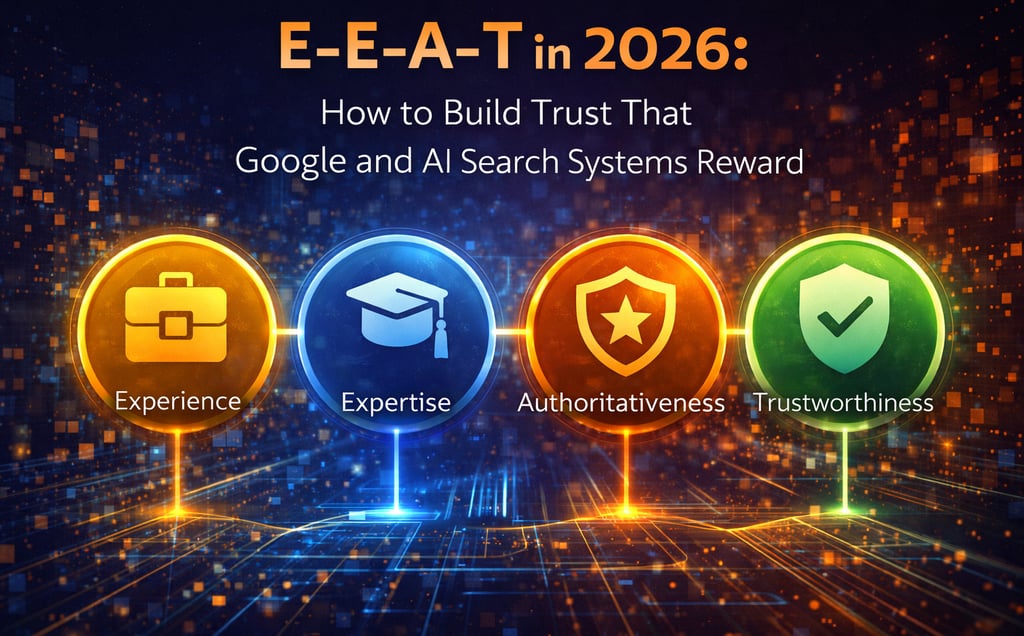
E-E-A-T — Experience, Expertise, Authoritativeness, and Trustworthiness.
If your content lacks these signals, it may struggle to rank—no matter how well it is optimized.
Because modern search is not just about relevance.
It’s about credibility.
What E-E-A-T Really Means
E-E-A-T is how search engines evaluate whether your content can be trusted.
Experience
Experience refers to real-world knowledge.
Content created from firsthand experience is more valuable than generic information. For example, case studies, practical insights, and real examples demonstrate that your content is based on actual work, not just theory.
Expertise
Expertise is about depth of knowledge.
Search engines evaluate whether your content demonstrates a strong understanding of the topic. This includes how well you explain concepts, the clarity of your insights, and the completeness of your coverage.
Authoritativeness
Authority comes from recognition.
If your website or brand is frequently mentioned, referenced, or linked to by others, it signals credibility. Authority is built both on your site and across the web.
Trustworthiness
Trust is the foundation.
Users must feel confident in your content. Clear information, accurate data, transparency, and consistency all contribute to trust.
Without trust, other signals lose value.
Why E-E-A-T Matters More in 2026
The growth of AI has changed the content landscape.
Millions of pages can now be generated quickly. This has increased competition and made it harder for search engines to identify reliable sources.
As a result, search engines rely more heavily on E-E-A-T signals to filter content.
AI-driven search systems also prioritize trusted entities and authoritative sources when generating answers.
This means that building trust is no longer optional.
It is essential for visibility.
How Search Engines Evaluate E-E-A-T
Search engines use multiple signals to assess credibility.
They analyze content depth to determine whether your information is comprehensive and useful.
They evaluate backlinks and mentions to understand how your brand is perceived externally.
They look at consistency across your website and other platforms to confirm your identity and expertise.
User behavior also plays a role. If users engage with your content and find it helpful, it reinforces trust signals.
These factors combine to form an overall picture of your authority.
How to Build E-E-A-T on Your Website
Building E-E-A-T requires a structured approach.
Start by showcasing real expertise. Include case studies, examples, and insights based on actual experience.
Create clear author profiles that highlight qualifications and background. This helps search engines associate your content with credible individuals.
Maintain consistent content quality. Publishing well-structured, informative articles over time strengthens your authority.
Use testimonials and proof points to build trust with users.
Ensure your website is transparent, with clear information about your business, services, and contact details.
Over time, these elements create a strong foundation of credibility.
E-E-A-T and AI Search
AI-powered search systems rely on trusted sources to generate answers.
They do not simply pull information from random pages. Instead, they prioritize content that demonstrates authority and reliability.
If your website consistently provides high-quality, trustworthy information, it is more likely to be referenced in AI-generated results.
This makes E-E-A-T a key factor in future search visibility.
Common E-E-A-T Mistakes
Many websites attempt to improve E-E-A-T but focus on superficial changes.
Adding generic author names without real expertise does not build trust.
Publishing large volumes of content without depth can weaken credibility.
Ignoring brand building limits authority signals.
Relying only on on-page optimization without external validation also reduces effectiveness.
True E-E-A-T comes from consistent, meaningful signals—not shortcuts.
The Strategic Advantage
Businesses that invest in E-E-A-T gain long-term benefits.
Their content becomes more stable in rankings.
Their brand becomes more recognizable.
Their visibility in AI-driven search improves.
Over time, this creates a compounding advantage.
Final Thoughts
SEO in 2026 is not just about optimizing pages.
It is about proving credibility.
E-E-A-T represents the shift from content quantity to content quality, from keyword targeting to trust building.
Websites that demonstrate real experience, deep expertise, strong authority, and consistent trustworthiness will continue to perform well in modern search environments.
Because in the future of SEO, the most important ranking factor is not just relevance.
It is trust.