
From Traffic to Revenue: How to Build an SEO Strategy That Actually Converts
Learn how to shift from traffic-based SEO to a revenue-driven strategy that prioritizes buyer intent, high-converting pages, and measurable business growth.
2/12/20262 min read

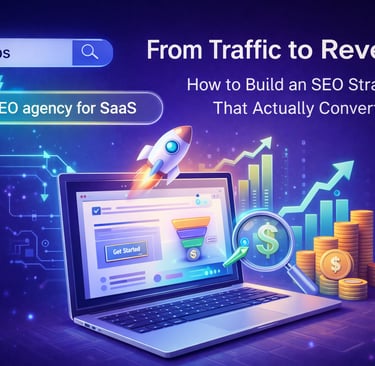
More traffic doesn’t guarantee more revenue.
Many businesses invest heavily in SEO, celebrate growing organic sessions, and still wonder why sales don’t move. The issue isn’t visibility — it’s alignment.
SEO should not be a traffic strategy.
It should be a revenue strategy.
The Traffic Trap
Traditional SEO focuses on rankings and volume. The assumption is simple: more visitors equal more customers.
But traffic without intent rarely converts.
A website can rank for dozens of high-volume keywords and still generate little business impact. If those visitors are researching, browsing, or casually exploring, they may never become buyers.
Revenue-driven SEO starts by asking a different question:
Which searches signal buying intent?
Start With Business Goals, Not Keywords
Before targeting any keyword, define what actually drives profit in your business.
Which services generate the highest margin?
Which offers close the fastest?
Which pages already convert well?
Your SEO strategy should amplify those assets first.
Instead of optimizing everything, you prioritize the pages and search terms closest to revenue.
Target Intent, Not Just Volume
There’s a major difference between:
“what is SEO”
and
“AI-powered SEO agency for SaaS”
One attracts learners.
The other attracts decision-makers.
High-volume keywords build visibility. High-intent keywords build pipelines.
Revenue-focused SEO balances both — but prioritizes the latter.
Optimize for Conversion
Ranking is only half the equation.
If a page ranks but doesn’t clearly communicate value, build trust, and guide action, it will not convert.
True revenue SEO connects search intent with persuasive messaging. It ensures that when the right visitor arrives, the path to action is obvious and frictionless.
SEO and conversion strategy must work together — not operate in isolation.
Measure What Matters
If you’re only tracking traffic and rankings, you’re missing the real performance indicators.
Revenue-driven SEO evaluates:
Leads generated from organic traffic
Conversion rates
Revenue contribution from search
These metrics reveal whether SEO is functioning as a growth engine — or just a visibility channel.
Where AI Makes the Difference
AI-powered systems enhance this entire process. They help identify high-intent opportunities, detect underperforming pages, and uncover gaps affecting conversion performance.
Instead of reacting to traffic drops, you adjust strategy proactively.
That’s how SEO becomes predictable.
Final Thoughts
Traffic is easy to chase.
Revenue requires structure.
When your SEO strategy is aligned with business objectives, focused on intent, and optimized for conversion, organic search becomes more than a marketing tactic.
It becomes a scalable growth system.
Because predictable revenue doesn’t come from more visitors.
It comes from the right ones.