
Internal Linking in 2026: How to Build a Structure That Search Engines Understand
Discover how a smart internal linking strategy improves crawlability, boosts page authority, and helps search engines interpret your content ecosystem.
3/11/20263 min read
Many SEO discussions focus on keywords, backlinks, and content creation. While these elements are important, one of the most powerful and often overlooked ranking factors is internal linking.
Internal links connect pages within your website, helping search engines understand how content is related and which pages are most important. When structured correctly, internal linking strengthens topical authority, improves crawlability, and distributes ranking power across your site.
In 2026, as search engines rely more on AI-driven understanding of topics and entities, internal linking has become even more critical.
What Internal Linking Actually Does
Internal linking is the practice of connecting pages on your own website through hyperlinks.
While it may seem simple, internal links serve several important purposes. They help search engines discover new pages, understand the relationship between topics, and determine which pages should carry the most authority.
When search engines crawl your website, they follow links to move from one page to another. The structure of those links helps them interpret your site’s content hierarchy.
Without clear internal linking, even high-quality pages may struggle to gain visibility.
Internal Links vs Backlinks
Backlinks are links from other websites that point to your pages. They are often considered a strong signal of external authority.
Internal links serve a different role.
They distribute authority across your website and guide both users and search engines through your content ecosystem.
For example, when a high-authority page on your site links to another page, it passes part of its ranking strength. This process helps newer or less visible pages gain traction in search results.
In many cases, effective internal linking can significantly improve the performance of existing content without requiring additional backlinks.
How Search Engines Interpret Internal Links
Search engines analyze several aspects of internal linking to understand your website.
One important factor is page hierarchy. Pages that receive more internal links are often interpreted as more important within the site structure.
Anchor text also plays a role. The words used in a link help search engines understand what the linked page is about.
Another factor is crawl paths. If a page is difficult to reach through internal links, search engines may treat it as less significant or may not index it efficiently.
Together, these signals help search engines map the structure of your website.
The Pillar and Cluster Model
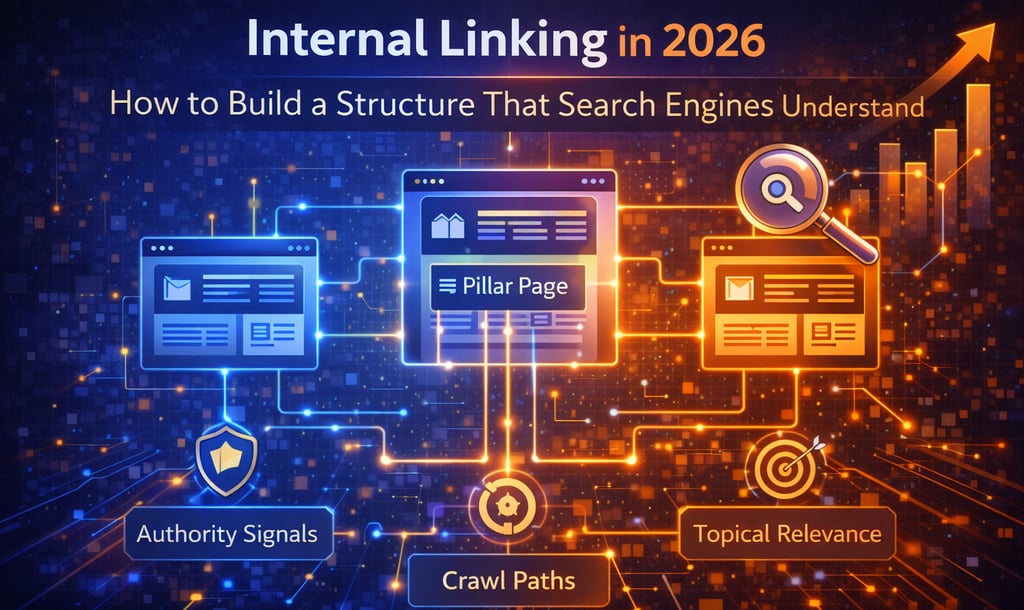
One of the most effective internal linking strategies is the pillar-and-cluster model.
In this structure, a comprehensive pillar page covers a core topic in depth. Supporting articles explore related subtopics and link back to the pillar page.
For example, a pillar page about modern SEO strategy might link to supporting articles about technical SEO, AI search, internal linking, programmatic SEO, and entity optimization.
These supporting articles also link to each other when relevant.
This structure creates a clear topic ecosystem that search engines can easily interpret.
Common Internal Linking Mistakes
Despite its importance, internal linking is often implemented poorly.
One common issue is orphan pages. These are pages that exist on a website but are not linked from other pages, making them difficult for search engines to discover.
Another problem is random linking without a clear strategy. Links should reinforce topic relationships rather than appearing arbitrarily within content.
Excessive linking can also dilute authority. When a page contains too many links, each link passes less value.
Finally, weak or generic anchor text can make it harder for search engines to understand the context of a link.
Avoiding these mistakes helps create a stronger and clearer site structure.
Internal Linking and Topical Authority
Internal linking plays a central role in building topical authority.
When related pages consistently link to each other, they signal a deeper level of expertise around a subject. Search engines can see that your website does not simply mention a topic once but explores it thoroughly across multiple pages.
This interconnected structure strengthens your authority within a topic area and improves your ability to rank for related queries.
Over time, well-structured internal linking helps search engines recognize your website as a trusted source of information.
Why Internal Linking Matters for AI Search
Modern search engines increasingly rely on AI systems to interpret content relationships.
These systems analyze how topics connect across pages and how information flows through a website.
Clear internal linking helps AI-driven search systems understand your knowledge structure. It allows them to identify main topics, supporting concepts, and the overall expertise of your website.
As AI-powered search experiences continue to grow, structured linking will become even more important.
The Strategic Advantage
Internal linking offers one of the most efficient ways to improve SEO performance.
Unlike backlinks, which depend on external websites, internal links are completely within your control. By refining your internal structure, you can strengthen the visibility of existing content without creating new pages or earning additional links.
When combined with strong content and topical authority, internal linking becomes a powerful tool for long-term organic growth.
Final Thoughts
SEO success is not only about producing content or earning backlinks. It is also about building a structure that search engines can clearly understand.
Internal linking creates that structure.
By connecting related pages, guiding search engines through your content ecosystem, and reinforcing topic relationships, internal links help transform individual articles into a cohesive knowledge resource.
In 2026, websites that invest in thoughtful internal linking will gain a clear advantage in search visibility.
Because when search engines understand your structure, they can better recognize your authority.