
Programmatic SEO in 2026: How to Scale Thousands of Pages Without Losing Quality
Learn how programmatic SEO helps businesses scale thousands of search-optimized pages using structured data, templates, and AI—without sacrificing quality or authority.
3/4/20263 min read
Scaling SEO used to mean publishing more content.
Write more blogs. Target more keywords. Build more backlinks.
But as search competition increased, this approach became inefficient. Creating thousands of pages manually is expensive, slow, and difficult to maintain.
Programmatic SEO solves that problem.
In 2026, many of the fastest-growing websites are not scaling content manually — they are building structured systems that generate high-quality pages at scale.
When done correctly, programmatic SEO can create thousands of valuable pages while maintaining strong authority and user experience.
What Programmatic SEO Actually Is
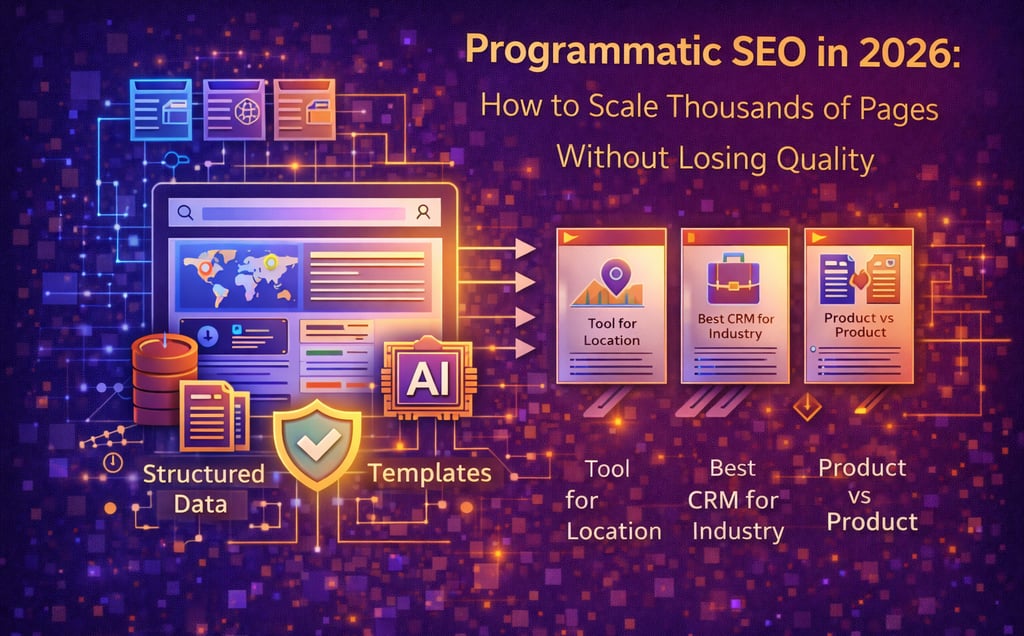
Programmatic SEO is the process of generating large numbers of search-optimized pages using structured data and templates.
Instead of writing each page individually, you design a scalable framework where content is dynamically created based on a dataset.
For example, a platform might generate pages for:
Product comparisons
Location-based services
Software integrations
Industry use cases
Tool directories
Each page targets a unique search intent while sharing a consistent structure.
This allows websites to capture long-tail search demand across thousands of queries.
Why Programmatic SEO Works
Search demand is far larger than most businesses realize.
Millions of queries exist that follow similar patterns, such as:
“Best CRM for startups”
“Best CRM for real estate”
“Best CRM for consultants”
Manually creating pages for each variation would take enormous time.
Programmatic SEO identifies these patterns and builds structured pages that address each intent efficiently.
The result is wider visibility across long-tail search queries that competitors often ignore.
Examples of Programmatic SEO in Action
Many well-known companies rely heavily on programmatic SEO.
Travel platforms create pages for thousands of destinations.
Financial tools generate comparison pages for different scenarios.
Software platforms build integration and feature-based pages.
These pages are not thin duplicates. They are built using structured templates combined with unique data points.
This structure allows websites to scale while still providing meaningful information to users.
When Programmatic SEO Makes Sense
Programmatic SEO works best when your business has structured data or repeatable patterns.
This could include:
Locations
Products
Integrations
Comparisons
Industry categories
Tools or resources
Without a reliable data source, programmatic pages risk becoming shallow.
The key is pairing automation with meaningful information.
The Risk of Thin Content
One of the biggest mistakes in programmatic SEO is scaling without quality control.
If thousands of pages contain nearly identical content with minimal value, search engines may treat them as thin or duplicate.
To avoid this, each page must provide:
Unique context.
Relevant data.
Clear structure.
Useful information for users.
Programmatic SEO succeeds when templates are designed to deliver real value, not just keyword variations.
AI and Programmatic SEO
AI is transforming how programmatic SEO works.
Instead of static templates, AI can help enrich pages with contextual insights, dynamic summaries, and relevant supporting content.
This allows programmatic pages to feel more personalized and informative rather than repetitive.
AI also helps identify patterns in search demand, revealing new opportunities for scalable page creation.
Technical Foundations Matter
Programmatic SEO requires strong technical infrastructure.
Your website must handle:
Efficient crawling and indexing.
Clean URL structures.
Internal linking across generated pages.
Fast loading speeds.
Structured data implementation.
Without proper technical SEO, large-scale page generation can overwhelm search engines instead of helping them understand your site.
Balancing Scale and Authority
Scaling pages should strengthen authority, not dilute it.
The best programmatic SEO strategies integrate with a broader content ecosystem that includes:
Pillar content explaining core topics.
Supporting articles building topical authority.
Internal links connecting related pages.
When structured properly, programmatic SEO expands your topical coverage while reinforcing expertise.
The Strategic Advantage
Programmatic SEO allows businesses to capture search demand that competitors often overlook.
Instead of competing only for high-volume keywords, you dominate thousands of highly specific queries.
These long-tail searches often convert better because they represent clearer intent.
Over time, this creates a powerful acquisition engine that scales alongside your business.
Final Thoughts
Programmatic SEO is not about flooding the internet with automated pages.
It’s about building structured systems that expand visibility efficiently while maintaining quality.
When combined with strong technical foundations, authoritative content, and AI-driven insights, programmatic SEO becomes one of the most scalable growth strategies available.
Because in modern search, the companies that win aren’t just publishing more pages.
They’re building smarter systems.