
SEO Analytics in 2026: What Metrics Actually Matter (And What to Ignore)
Discover which SEO metrics actually matter in 2026—from conversions and revenue to high-intent performance—and learn which vanity metrics to ignore.
3/17/20265 min read
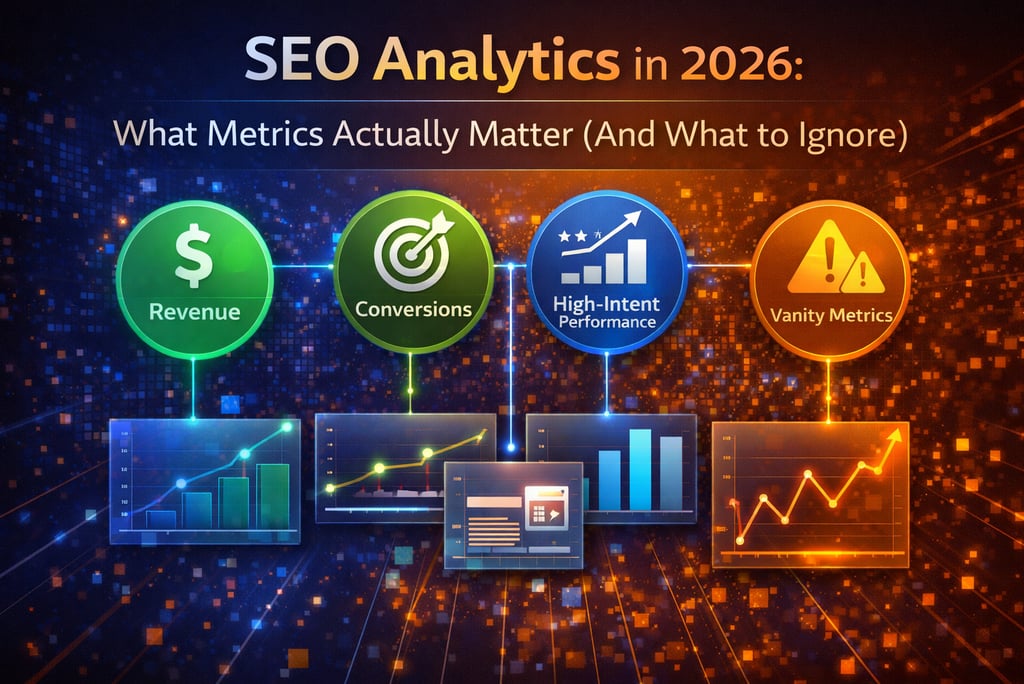
SEO has never had a data problem.
It has a clarity problem.
Most dashboards are filled with numbers—rankings, impressions, clicks, backlinks. Yet many businesses still struggle to answer a simple question:
Is SEO actually driving growth?
In 2026, the gap between data and decision-making is wider than ever. AI tools generate more insights, more reports, and more metrics—but not all of them matter.
The real advantage lies in knowing what to measure, what to ignore, and how to connect SEO performance to business outcomes.
The Problem With Traditional SEO Metrics
For years, SEO success was measured using:
Keyword rankings
Organic traffic
Impressions
While these metrics provide visibility into performance, they often lack context.
A page may rank higher but attract low-quality traffic.
Traffic may increase without improving conversions.
Impressions may grow without generating engagement.
These metrics show activity—not impact.
Without connecting them to outcomes, businesses risk optimizing for numbers that don’t drive real growth.
What Metrics Actually Matter in 2026
Modern SEO analytics focuses on business-aligned performance.
Conversion-Focused Metrics
Traffic only matters if it leads to action.
Tracking how many users convert from organic search—whether through form submissions, sign-ups, or purchases—provides a clearer picture of SEO effectiveness.
Understanding conversion rates by page and keyword helps prioritize high-value opportunities.
Revenue Attribution
SEO should contribute to revenue, not just visibility.
By connecting organic traffic to revenue data, businesses can identify which pages and keywords generate the most financial impact.
This shifts SEO from a marketing expense to a measurable growth channel.
High-Intent Keyword Performance
Not all keywords are equal.
Some queries indicate curiosity, while others signal strong buying intent.
Tracking performance for high-intent keywords provides better insight into the true value of your SEO strategy.
Ranking for fewer high-intent queries can be more valuable than ranking for many low-intent ones.
Page-Level Performance
Instead of focusing on overall site metrics, modern SEO analytics evaluates individual pages.
Which pages are driving conversions?
Which are losing rankings?
Which have growth potential?
Page-level insights allow for more targeted optimization and better resource allocation.
Engagement Signals
User behavior reveals how well content satisfies intent.
Metrics such as time on page, scroll depth, and interaction rates help determine whether users find your content useful.
Strong engagement signals indicate alignment with search intent and improve long-term performance.
Metrics That Are Often Misleading
Not all metrics deserve attention.
Some can distract from meaningful insights.
Ranking Fluctuations
Keyword rankings naturally change over time.
Daily or weekly fluctuations are common and often do not indicate long-term trends.
Focusing too heavily on short-term changes can lead to unnecessary adjustments.
Raw Traffic Growth
Traffic increases may look impressive, but they do not guarantee value.
If traffic comes from low-intent queries, it may not contribute to conversions or revenue.
Quality matters more than quantity.
Impressions Without Context
Impressions indicate visibility, but not engagement.
A page may appear in search results frequently without generating clicks or conversions.
Without context, impressions provide limited insight.
Backlink Counts
Not all backlinks are equally valuable.
A few high-quality, relevant links can be more impactful than many low-quality ones.
Focusing only on quantity can lead to ineffective strategies.
How AI Is Changing SEO Analytics
AI is transforming how businesses interpret SEO data.
Instead of manually analyzing reports, AI systems can identify:
Patterns in user behavior
Content performance gaps
Emerging keyword opportunities
Early signals of ranking changes
AI enables predictive insights rather than reactive analysis.
This allows businesses to act before performance declines rather than after.
Building a Reporting System That Drives Decisions
Effective SEO reporting is not about presenting data—it is about guiding decisions.
A strong reporting system focuses on:
Business outcomes over vanity metrics.
Trends over short-term fluctuations.
Page-level insights over general summaries.
Actionable recommendations over raw data.
Reports should clearly answer:
What is working?
What is not working?
What should we do next?
This clarity transforms SEO from a reporting exercise into a strategic growth tool.
The Strategic Advantage
Businesses that focus on meaningful SEO metrics gain a significant advantage.
They make better decisions.
They allocate resources more effectively.
They align SEO efforts with business goals.
Over time, this leads to more consistent and predictable growth.
Final Thoughts
SEO analytics in 2026 is not about tracking more data.
It is about tracking the right data.
When metrics are aligned with business outcomes, SEO becomes easier to measure, manage, and scale.
Because the true value of SEO is not in rankings or traffic.
It is in the growth those metrics create.
Frequently Asked Questions
What SEO metrics matter most in 2026?
The most useful metrics are conversions, revenue attribution, high-intent keyword performance, page-level performance, and engagement signals. These measures connect SEO activity to business outcomes instead of just visibility. They help show whether organic search is actually driving growth
Why are rankings and impressions not enough?
Rankings and impressions show visibility, but they do not prove impact. A page can rank higher, attract low-quality traffic, or appear often without generating clicks, engagement, conversions, or revenue. That is why they should be treated as context, not the main success metric.
How do conversions help measure SEO success?
Conversions show whether organic traffic leads to action, such as form submissions, sign-ups, or purchases. Tracking conversion rates by page and keyword gives a clearer view of SEO effectiveness and helps identify the highest-value opportunities.
Why should SEO reporting include revenue attribution?
Revenue attribution shows which pages and keywords contribute to financial impact, not just traffic. Connecting organic search to revenue helps position SEO as a measurable growth channel and makes it easier to prioritize work that supports business outcomes.
What are high-intent keywords?
High-intent keywords are queries that signal strong buying intent rather than simple curiosity. Tracking them helps reveal the real value of an SEO strategy, and ranking for fewer high-intent queries can be more valuable than ranking for many low-intent ones
Why focus on page-level SEO performance?
Page-level performance shows which individual pages drive conversions, lose rankings, or have growth potential. That makes optimization more targeted and helps allocate resources where they can have the biggest impact.
Which engagement signals matter for SEO?
Time on page, scroll depth, and interaction rates are useful engagement signals. They help show whether users find the content useful and whether it matches search intent, which supports stronger long-term performance.
Should you worry about ranking fluctuations?
Usually, no. Daily or weekly ranking changes are normal and often do not reflect long-term trends. Overreacting to short-term movement can lead to unnecessary adjustments instead of better decisions.
Is raw traffic growth a good SEO goal?
Not by itself. Traffic growth can look impressive, but it does not guarantee value if the visits come from low-intent queries. Quality matters more than quantity when the goal is conversions or revenue.
Do impressions tell you if SEO is working?
Not on their own. Impressions show visibility, but they do not show engagement, clicks, or conversions. Without context, they offer limited insight into whether SEO is driving meaningful results.
Are backlink counts still useful?
Backlink counts can be misleading if they ignore quality. A few relevant, high-quality links can matter more than many low-quality ones, so quantity alone is not a reliable measure of SEO value
How is AI changing SEO analytics?
AI is helping businesses spot patterns in user behavior, content performance gaps, emerging keyword opportunities, and early ranking changes. That shifts analysis from reactive reporting toward more predictive decision-making.
What should an SEO report focus on?
A strong SEO report should focus on business outcomes, trends, page-level insights, and actionable recommendations. It should answer what is working, what is not working, and what should happen next.
How does better SEO reporting help growth?
Better reporting helps teams make better decisions, allocate resources more effectively, and align SEO work with business goals. Over time, that creates more consistent and predictable growth.