
SEO Audit Checklist for 2026: A Step-by-Step Guide to Find and Fix Issues
Not sure what’s holding your SEO back? This guide breaks down a complete audit process to identify gaps and turn your website into a growth engine.
4/6/20262 min read
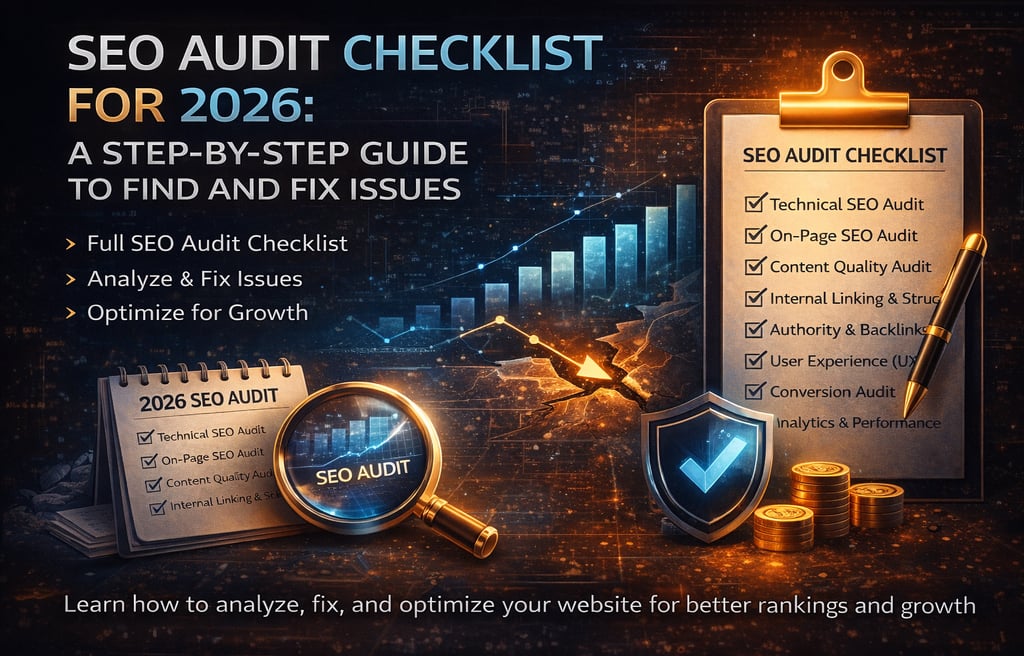
SEO success is not just about creating content or building links. It starts with understanding what’s working, what’s broken, and what’s missing. That’s where an SEO audit comes in. In 2026, SEO audits are no longer just technical—they evaluate your entire growth system.
This checklist will help you identify issues and unlock opportunities.
What Is an SEO Audit?
An SEO audit is a structured evaluation of your website’s performance across:
Technical SEO
Content quality
Authority signals
User experience
Conversion readiness
It helps you identify gaps that may be limiting your growth.
Step 1: Technical SEO Audit
Start with the foundation.
Check Crawlability & Indexing
Are all important pages indexed?
Are there crawl errors?
Is your sitemap submitted?
Website Speed & Performance
Does your site load quickly?
Are images optimized?
Is mobile performance strong?
Mobile Optimization
Is your site fully responsive?
Does it provide a smooth mobile experience?
Step 2: On-Page SEO Audit
Next, evaluate how well your pages are optimized.
Title Tags & Meta Descriptions
Are they optimized for keywords?
Are they compelling for clicks?
Headings & Structure
Is your content easy to scan?
Are headings properly structured?
Keyword & Intent Alignment
Does the page match search intent?
Is the content answering user queries clearly?
Step 3: Content Audit
Content is the core of SEO.
Content Quality
Is your content valuable and unique?
Does it go beyond basic information?
Content Depth
Are topics covered comprehensively?
Do you have supporting articles?
Content Freshness
Are older articles updated regularly?
Step 4: Internal Linking & Structure
A strong structure improves both rankings and user experience.
Are pages properly interconnected?
Do you have topic clusters?
Is navigation clear?
Step 5: Authority & Backlink Audit
Authority drives rankings.
Do you have high-quality backlinks?
Are links relevant to your niche?
Are there toxic or spammy links?
Step 6: User Experience (UX)
SEO is not just for search engines—it’s for users.
Is your website easy to navigate?
Are pages visually clear and engaging?
Is there friction in the user journey?
Step 7: Conversion Audit
Traffic without conversion is wasted.
Do you have clear calls to action?
Are landing pages optimized?
Are you capturing leads effectively?
Step 8: Analytics & Performance
Measure what matters.
Which pages drive traffic?
Which pages convert?
Where are users dropping off?
Common SEO Audit Mistakes
Focusing only on technical issues
Ignoring content quality
Not aligning with business goals
Performing audits without execution
How Often Should You Do an SEO Audit?
Small websites → every 6 months
Growing websites → every 3 months
High-growth businesses → continuous monitoring
The Strategic Perspective
An SEO audit is not just a checklist. It is a growth diagnostic tool. It helps you understand where to focus your efforts for maximum impact.
Final Thoughts
SEO success begins with clarity. An audit gives you that clarity. By identifying gaps and fixing issues systematically, you turn SEO into a predictable growth channel. Because in 2026, the businesses that win are not guessing. They are optimizing with precision.