
SEO Case Study in 2026: How We Grew Traffic and Revenue Step-by-Step
Discover how a system-driven SEO approach transforms visibility into revenue through a practical, step-by-step case study.
3/26/20262 min read
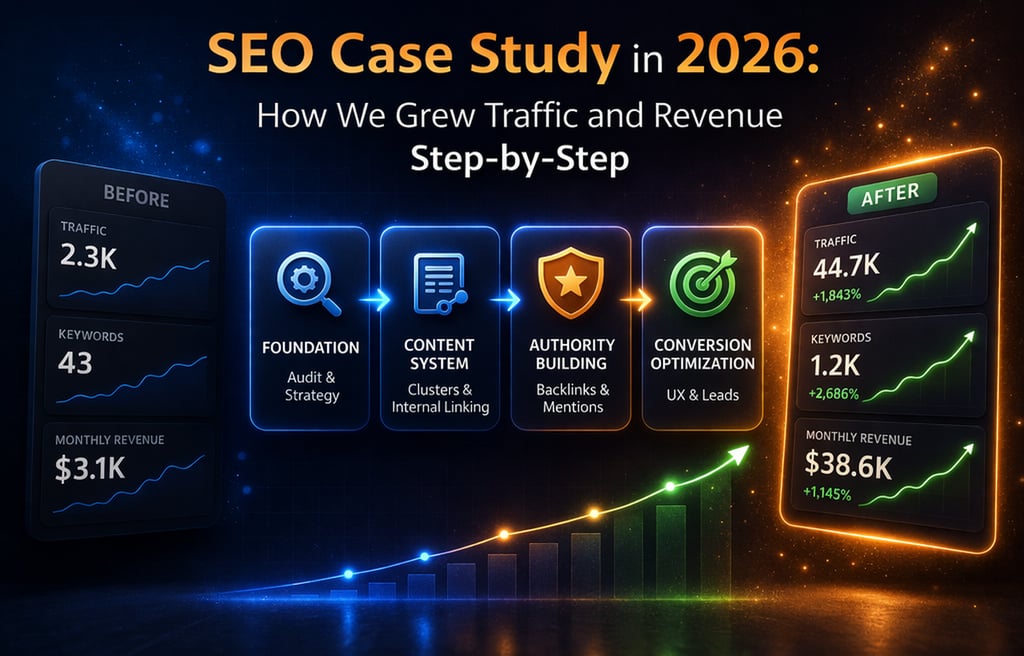

SEO sounds powerful in theory.
But what most businesses really want to know is:
Does it actually work? And how does it translate into real growth?
This case study breaks down a structured SEO approach—showing exactly how traffic, leads, and revenue can grow when strategy and execution are aligned.
Project Overview
For this case study, let’s consider a service-based business operating in a competitive digital space.
Starting Point
Low organic visibility
Minimal keyword rankings
Inconsistent traffic
No clear conversion path
The website had content, but it lacked structure, authority, and a clear strategy.
The Core Challenge
The biggest issue was not the absence of effort.
It was the absence of a system.
Content was scattered.
Internal linking was weak.
Pages were not aligned with search intent.
And most importantly—there was no connection between SEO and revenue.
The Strategy Applied
Instead of focusing on isolated tactics, the approach centered on building a complete SEO system.
This included:
Creating content clusters around core topics
Strengthening internal linking
Improving search intent alignment
Building authority through backlinks and mentions
Optimizing pages for conversions
Each element supported the others.
Step-by-Step Execution
Phase 1: Foundation (Month 1)
The first step was a complete audit.
Technical issues were identified and resolved.
Site structure was improved to support scalability.
Keyword research was aligned with search intent rather than just volume.
This phase created the base for future growth.
Phase 2: Content System (Month 2–3)
Next, content was restructured.
Instead of publishing random articles, the focus shifted to building topic clusters.
Pillar pages were created for core topics.
Supporting articles were developed to cover related subtopics.
Internal links connected all pages into a cohesive system.
This significantly improved topical authority.
Phase 3: Authority Building (Month 3–4)
With content in place, the focus moved to trust and credibility.
High-quality backlinks were acquired from relevant sources.
Brand mentions increased across platforms.
The website began to establish itself as an authority within its niche.
This strengthened rankings across multiple keywords.
Phase 4: Conversion Optimization (Month 4–5)
Traffic alone was not the goal.
Pages were optimized to convert visitors into leads.
Clear calls to action were added.
User experience was improved.
Trust signals such as testimonials and proof points were introduced.
This ensured that traffic translated into measurable results.
Phase 5: Scaling and Optimization (Ongoing)
Once the system was working, the focus shifted to scaling.
Existing content was updated and expanded.
New clusters were added.
Performance data guided ongoing improvements.
Growth became consistent and compounding.
Results Achieved
Within a few months, the impact was clear.
Significant increase in organic traffic
Improved rankings across multiple keywords
Higher engagement and time on site
Strong growth in leads and inquiries
Most importantly, SEO began contributing directly to business growth.
Key Learnings
Several insights emerged from this process.
SEO works best when it is treated as a system, not a checklist.
Content structure matters more than content volume.
Authority and trust are essential for sustainable rankings.
Conversion optimization is critical for turning traffic into results.
These lessons reinforce the importance of a holistic approach.
Why This Strategy Worked
The success of this approach came from alignment.
Content, structure, authority, and conversion were all connected.
Instead of optimizing individual elements, the strategy focused on building a complete ecosystem.
This created momentum.
Each improvement supported the next, leading to compounding growth over time.
Final Thoughts
SEO is often misunderstood as a slow or uncertain channel.
But when executed correctly, it becomes one of the most powerful growth drivers.
This case study demonstrates that success is not about isolated tactics.
It is about building a system that connects:
Content → Authority → Traffic → Conversion → Revenue
Because in 2026, the businesses that win in SEO are not just optimizing pages.
They are building predictable growth engines.