
SEO Content Clusters in 2026: How Topic Ecosystems Drive Search Rankings
Discover how building content clusters and pillar pages can organize your website’s content, improve internal linking, and boost search visibility.
3/16/20263 min read
SEO has evolved far beyond optimizing individual pages for specific keywords.
In the past, many websites focused on creating standalone articles targeting different search terms. While this approach sometimes worked, it often resulted in scattered content that lacked clear structure.
In 2026, search engines evaluate topic ecosystems rather than isolated pages. They analyze how content connects across a website to determine whether a site demonstrates real expertise within a subject.
This is where content clusters become essential. By organizing content around central topics and linking related articles together, websites create a structure that both users and search engines can understand.
What a Content Cluster Is
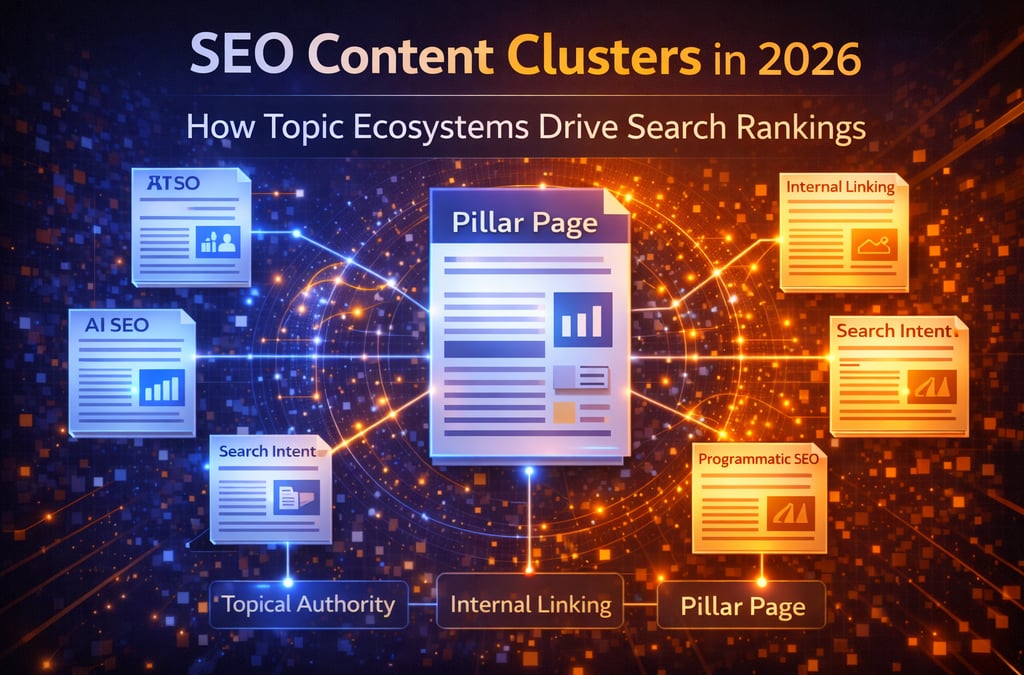
A content cluster is a group of related pages built around a central topic.
The structure typically includes a pillar page, which covers the main topic in depth, along with several supporting articles that explore specific subtopics.
Each supporting article links back to the pillar page and often connects with other related articles in the cluster.
This structure creates a clear content ecosystem where every page contributes to a larger theme.
Instead of publishing disconnected articles, websites build interconnected knowledge hubs.
Why Content Clusters Improve Rankings
Search engines increasingly focus on topical authority when evaluating websites.
If a site publishes only one article about a topic, it may appear less authoritative than a site that covers the subject from multiple perspectives.
Content clusters signal that your website has deeper expertise.
When several articles consistently link to one another and address related questions, search engines recognize that your site provides comprehensive coverage of the topic.
This strengthens trust and increases the likelihood of ranking across many related search queries.
The Role of Pillar Pages
The pillar page acts as the central resource within a content cluster.
It typically provides a broad overview of the main topic and links to supporting articles that explore individual aspects in more detail.
For example, a pillar page about modern SEO strategy might include links to articles about:
AI-driven SEO
Programmatic SEO
Internal linking strategies
Search intent optimization
Content refresh strategies
The pillar page acts as a hub that connects these related pieces into one organized structure.
Supporting Articles in a Cluster
Supporting articles focus on narrower topics within the main theme.
These articles allow you to explore specific questions in depth while contributing to the overall authority of the cluster.
For example, if your pillar page discusses SEO strategy, supporting articles might include:
How internal linking improves rankings
The role of search intent in modern SEO
How programmatic SEO scales content
Why entity-based SEO matters
Each article strengthens the topic ecosystem while targeting its own search queries.
The Importance of Internal Linking
Internal linking plays a crucial role in content clusters.
Links help search engines understand how different pages relate to one another. When supporting articles consistently link back to the pillar page and to each other, they create a clear map of topic relationships.
This structure allows search engines to interpret your website as a comprehensive knowledge resource rather than a collection of unrelated pages.
Internal linking also distributes authority across the cluster, helping new articles gain visibility more quickly.
Content Clusters and AI Search
Modern AI-powered search systems analyze content relationships to identify trusted sources of information.
When a website demonstrates strong topical coverage through clusters, it becomes easier for search engines to interpret the site's expertise.
This structured approach improves the chances that your content will be referenced in AI-generated answers and summaries.
As search technology continues to evolve, organized content ecosystems will play an even greater role in search visibility.
How to Build a Content Cluster
Creating a content cluster starts with choosing a core topic that aligns with your expertise.
First, develop a comprehensive pillar page that introduces the topic and outlines the key areas users may want to explore.
Next, create supporting articles that dive deeper into each subtopic.
These articles should link back to the pillar page and connect with other relevant articles within the cluster.
Over time, you can expand the cluster by adding more specialized articles, gradually strengthening your site's authority within the subject.
The Strategic Advantage
Content clusters help websites build long-term SEO strength.
Instead of chasing isolated keywords, this approach focuses on developing meaningful topic coverage that grows over time.
As your cluster expands, your site becomes more likely to rank for a wide range of related queries.
Users also benefit from a better experience, as they can easily navigate between related topics and gain deeper understanding.
Final Thoughts
Search engines are increasingly designed to understand topics rather than individual keywords.
Websites that organize their content into structured clusters provide clearer signals of expertise and authority.
By building pillar pages, creating supporting articles, and connecting them through internal links, businesses can develop powerful content ecosystems that support long-term search growth.
In 2026, the websites that succeed in SEO are not just publishing articles.
They are building knowledge hubs that search engines trust.