
SEO Conversion Optimization in 2026: Turning Traffic Into Revenue
Getting traffic is only half the battle. Discover how SEO conversion optimization helps turn visitors into leads and customers.
3/19/20263 min read
Getting traffic is no longer the hardest part of SEO.
Converting that traffic is.
Many businesses invest heavily in rankings, content, and backlinks—only to find that their organic traffic doesn’t translate into leads or revenue.
In 2026, successful SEO is not just about visibility.
It’s about conversion optimization.
Because traffic without conversion is just noise.
Why Traffic Alone Is Not Enough
A website can generate thousands of monthly visitors and still struggle to grow.
Why?
Because not all traffic is valuable—and not all pages are designed to convert.
SEO brings users to your site, but what happens next determines whether that traffic has real business impact.
Without a clear conversion strategy, even high rankings fail to deliver meaningful results.
The SEO-to-Conversion Gap
Most businesses lose potential customers in the gap between search intent and page experience.
A user searches with a specific goal.
They land on a page that partially answers their question.
But the next step is unclear.
There is no strong call to action.
No clear direction.
No compelling reason to act.
This gap is where conversions are lost.
Closing it requires aligning your content, design, and messaging with user intent.
Key Conversion Factors in SEO
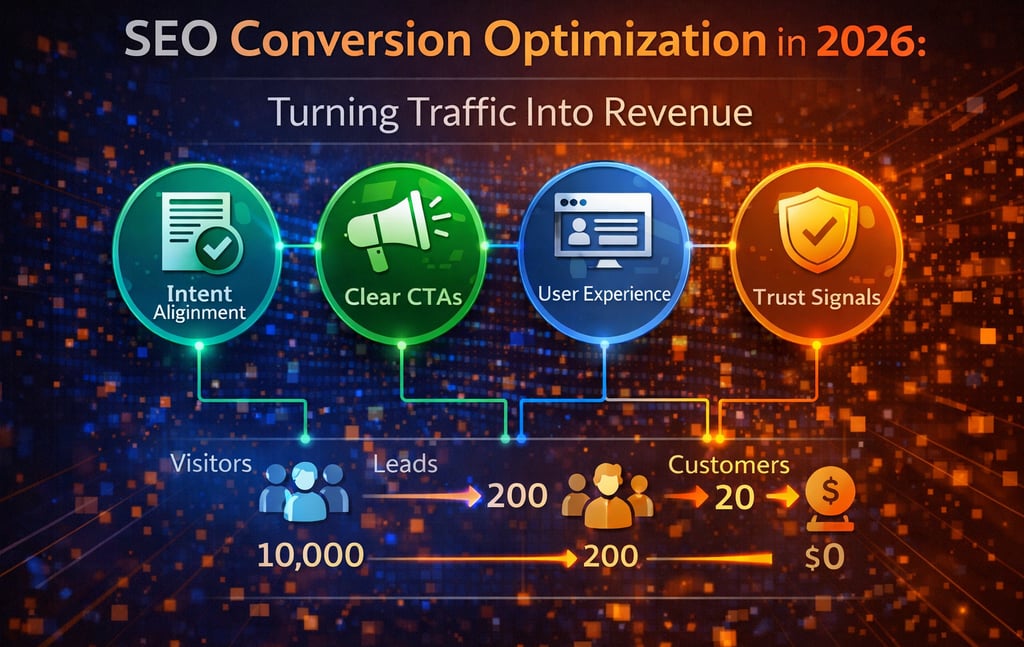
Intent Alignment
The closer your page matches the user’s intent, the higher the chance of conversion.
If someone searches for “best SEO tools,” they expect comparisons—not a general blog post.
Matching intent builds trust and reduces friction.
Clear Calls to Action (CTAs)
Every page should guide users toward a next step.
Whether it’s booking a consultation, signing up, or exploring a service, the action should be obvious and easy to take.
Weak or hidden CTAs often lead to missed opportunities.
Page Structure and User Experience
Users scan pages quickly.
A clear structure with headings, concise sections, and logical flow helps users understand your message faster.
Confusing layouts or long, unstructured content can reduce engagement and conversions.
Trust Signals
Trust is essential for conversion.
Elements such as testimonials, case studies, client logos, and data-backed results increase credibility.
When users trust your expertise, they are more likely to take action.
Content Clarity
Clear, simple messaging outperforms complex explanations.
Users should immediately understand:
What you offer
How it helps them
Why they should choose you
Clarity reduces hesitation and improves decision-making.
High-Converting Page Types
Certain types of pages naturally convert better than others.
Comparison Pages
Pages comparing tools, services, or solutions capture users who are evaluating options.
These users often have high purchase intent.
Service and Landing Pages
Dedicated landing pages focused on a specific offering provide clear messaging and strong CTAs.
They are essential for converting traffic into leads.
Product Pages
Detailed product pages with benefits, features, and proof points help users make informed decisions.
Case Studies
Real-world examples demonstrate results and build trust.
They help users visualize how your solution can work for them.
Optimizing Pages for Higher Conversions
Improving conversion rates does not always require major changes.
Small optimizations can have significant impact.
Start with the top section of your page. The value proposition should be clear immediately.
Reduce friction by simplifying forms and minimizing unnecessary steps.
Use proof elements such as testimonials or data to reinforce credibility.
Ensure that the page answers the user’s primary question quickly and effectively.
These adjustments make it easier for users to take action.
How AI Is Transforming Conversion Optimization
AI is playing a growing role in conversion optimization.
Modern systems can analyze user behavior to identify where visitors drop off or lose interest.
AI can also support personalization, tailoring content and offers based on user intent and behavior.
Additionally, AI-driven testing helps identify which page variations perform best.
This allows businesses to continuously improve conversion rates based on real data.
The Strategic Advantage
Businesses that focus on conversion optimization gain more value from their existing traffic.
Instead of constantly chasing new visitors, they improve the performance of current users.
This leads to:
Higher return on SEO investment
Better user experience
More predictable revenue growth
Conversion optimization turns SEO into a complete growth system.
Final Thoughts
SEO does not end when a user clicks your page.
That is where it begins.
In 2026, the most successful websites are not just those that attract traffic—but those that convert it.
By aligning intent, improving user experience, and guiding users toward action, businesses can turn organic visibility into real results.
Because the true goal of SEO is not traffic.
It’s growth.