
SEO for High-Growth SaaS Companies in 2026: A Scalable Framework
Discover a scalable SEO framework for high-growth SaaS companies in 2026—designed to drive qualified traffic, product-led growth, and predictable recurring revenue.
2/24/20262 min read
SaaS SEO is different.
It’s not about traffic spikes.
It’s not about viral blog posts.
And it’s definitely not about ranking for broad, generic keywords.
For high-growth SaaS companies, SEO must support one thing: predictable recurring revenue.
In 2026, the SaaS brands winning organic search aren’t publishing more content — they’re building structured growth frameworks.
Why SaaS SEO Requires a Different Approach
SaaS businesses operate with:
Longer sales cycles
Multiple decision-makers
Product-led funnels
Recurring revenue models
This changes everything.
You’re not just generating leads.
You’re acquiring users who may convert weeks — or months — later.
That requires deeper intent mapping and smarter content alignment.
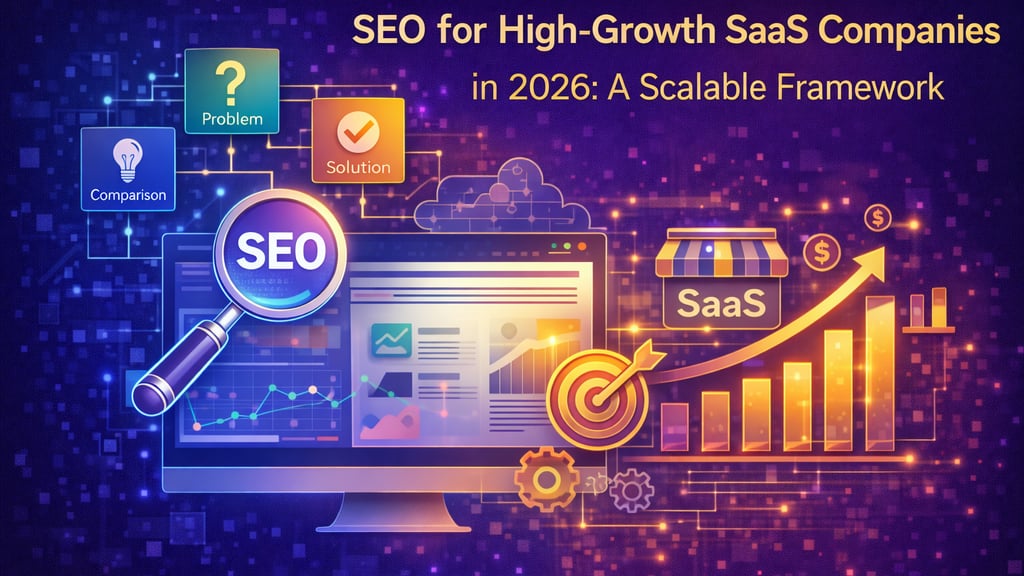
Intent Mapping Across the SaaS Funnel
High-growth SaaS SEO aligns with each stage of the buyer journey.
Early stage users search for problems.
Mid-stage users compare solutions.
Late-stage users evaluate specific platforms.
A scalable SaaS SEO framework builds visibility across all three — but prioritizes bottom-funnel commercial intent.
Because in SaaS, acquisition cost and lifetime value matter more than raw traffic.
Product-Led Content Strategy
In 2026, generic blog content no longer drives sustainable growth for SaaS companies.
Winning SaaS brands build content around:
Product use cases
Feature comparisons
Integration guides
Industry-specific solutions
Instead of publishing disconnected articles, content ties directly to product value.
SEO becomes an extension of product marketing.
Building Topical Authority in Competitive Niches
Most SaaS markets are crowded.
That means authority must be engineered.
High-growth SaaS SEO requires:
Structured topic clusters
Deep coverage of core solution categories
Strategic internal linking
Consistent content refinement
When search engines recognize your platform as a resource hub within your niche, ranking stability improves significantly.
Technical Infrastructure at Scale
SaaS websites often include:
Dynamic pages
Integration directories
Resource hubs
Documentation libraries
Technical SEO becomes critical.
Crawl efficiency, indexation control, structured data, and performance optimization directly influence scalability.
Without a strong technical foundation, growth plateaus quickly.
Authority & Backlink Strategy for SaaS
SaaS backlink acquisition should focus on:
Industry publications
Integration partners
Data-driven reports
Original research
Authority compounds when your platform becomes cited as a trusted source — not just mentioned in directories.
Relevance is more valuable than raw domain metrics.
Forecasting MRR Through SEO
The real power of SaaS SEO lies in forecasting.
When you model:
Target keyword opportunity
Traffic potential
Trial sign-up rates
Paid conversion percentages
Average lifetime value
SEO shifts from a marketing tactic to a revenue planning tool.
Organic growth becomes measurable against Monthly Recurring Revenue (MRR), not just sessions.
This is where high-growth SaaS companies separate from the rest.
The Scalable Framework
A modern SaaS SEO framework integrates:
Strategic intent targeting.
Product-aligned content clusters.
Technical scalability.
Authority acquisition.
Revenue forecasting.
Each component strengthens the others.
This creates compounding growth — not short-term traffic spikes.
Final Thoughts
In 2026, SaaS SEO isn’t about publishing more.
It’s about building systems.
Systems that attract the right users.
Systems that support product positioning.
Systems that forecast revenue impact.
Systems that scale alongside your growth goals.
Because for high-growth SaaS companies, SEO isn’t just visibility.
It’s a long-term acquisition engine.