
SEO Forecasting in 2026: How to Predict Organic Growth Before It Happens
Discover how SEO forecasting in 2026 uses data and AI-driven modeling to predict traffic, rankings, and revenue—turning organic search into a predictable growth channel.
2/23/20262 min read
For many businesses, SEO still feels unpredictable.
Rankings fluctuate. Traffic shifts. Algorithm updates create uncertainty. Growth appears inconsistent.
But mature SEO strategies don’t operate on hope.
In 2026, forecasting has become one of the most important competitive advantages in organic search.
Because when you can predict growth, you can plan for it.
Why SEO Feels Unpredictable
Most SEO campaigns lack structured modeling.
They focus on tasks:
Publishing content.
Building backlinks.
Fixing technical errors.
While these activities matter, they don’t automatically translate into measurable growth projections.
Without forecasting, SEO becomes reactive. You celebrate traffic increases and scramble when numbers dip.
Forecasting transforms SEO from reactive execution into strategic planning.
What SEO Forecasting Actually Means
SEO forecasting is the process of estimating future organic performance based on data, trends, and structured assumptions.
It connects:
Keyword opportunity
Ranking potential
Click-through behavior
Conversion rates
Revenue contribution
Instead of asking, “How are we performing?”
You ask, “Where are we likely to be in six months?”
That shift changes how decisions are made.
The Data Behind Accurate Forecasting
Strong forecasting models analyze:
Historical performance trends.
Keyword ranking distribution.
Search volume patterns.
Competitive positioning.
Conversion metrics tied to organic traffic.
Rather than guessing outcomes, projections are built from probability models and scenario planning.
AI systems now enhance this process by identifying ranking velocity patterns and growth correlations across similar sites and industries.
Forecasting becomes structured, not speculative.
Traffic Forecasting vs Revenue Forecasting
Traffic forecasting estimates potential organic visits based on ranking improvements.
Revenue forecasting goes deeper.
It evaluates:
Which keywords signal buying intent
Which landing pages convert best
What percentage of organic visitors become leads
Average deal value tied to organic acquisition
The difference is critical.
Traffic is visibility.
Revenue is business impact.
In 2026, serious SEO strategy forecasts both.
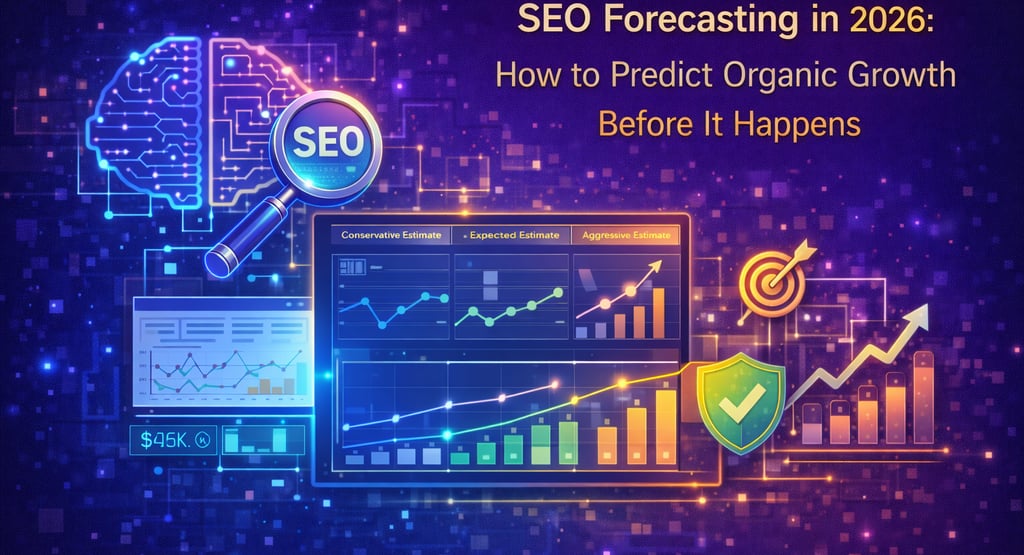
Scenario Planning: Conservative, Expected, Aggressive
Modern SEO forecasting doesn’t rely on a single number.
It models multiple scenarios:
A conservative case based on moderate ranking improvements.
An expected case based on steady authority growth.
An aggressive case based on strong execution and competitive gains.
This allows businesses to allocate resources with clarity.
Forecasting doesn’t promise outcomes. It models possibilities.
Where AI Changes the Equation
AI-powered forecasting tools analyze far more data than manual models ever could.
They identify:
Ranking momentum signals.
Competitive gaps likely to close.
Keyword clusters with rising demand.
Pages with high growth potential.
Instead of static spreadsheets, forecasts evolve as performance data updates.
That dynamic modeling increases accuracy over time.
Turning SEO Into a Predictable Channel
When forecasting is integrated into strategy, SEO shifts from experimentation to structured growth planning.
It allows you to:
Align content production with projected opportunity.
Invest in authority-building based on modeled impact.
Set realistic expectations with stakeholders.
Connect organic strategy directly to revenue planning.
SEO becomes measurable not just in hindsight — but in advance.
The Strategic Advantage
Businesses that forecast effectively gain clarity others lack.
They understand:
What growth is realistically achievable.
How long momentum takes to compound.
Where to focus effort for maximum impact.
How SEO contributes to future revenue.
This reduces uncertainty and increases confidence.
That confidence strengthens long-term investment in organic growth.
Final Thoughts
SEO will always involve variables.
But unpredictability often comes from a lack of modeling — not a lack of opportunity.
In 2026, forecasting is no longer optional for serious businesses. It’s the difference between hoping for growth and engineering it.
Because when you can predict organic performance, you can build around it.
And that’s when SEO stops being a tactic.
It becomes a strategic growth asset.