
SEO Forecasting Models in 2026: How to Estimate Traffic, Leads, and Revenue
Discover how to predict SEO performance with keyword, page, and funnel-based forecasting models that connect rankings to real business outcomes.
3/18/20263 min read
SEO is often seen as unpredictable.
Rankings fluctuate. Traffic changes. Results take time. For many businesses, this creates uncertainty around investment and expectations.
But in 2026, mature SEO strategies are no longer based on guesswork.
They are based on forecasting models.
When done correctly, SEO forecasting allows businesses to estimate future traffic, leads, and revenue—turning SEO from a vague marketing channel into a measurable growth system.
Why Most SEO Forecasts Are Wrong
Many SEO forecasts fail because they rely on assumptions without structure.
Common issues include:
Overestimating ranking potential
Ignoring competition
Not factoring conversion rates
Treating traffic as the final goal
Without connecting SEO performance to business outcomes, forecasts become unrealistic.
Accurate forecasting requires clear models, realistic assumptions, and alignment with revenue goals.
The Three Core SEO Forecasting Models
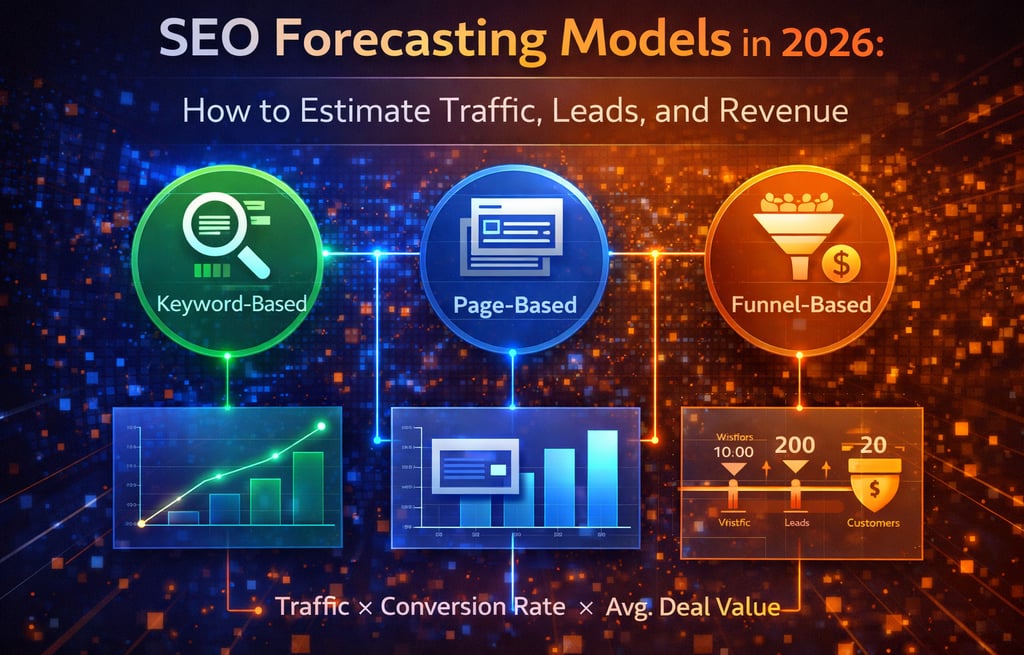
In 2026, effective SEO forecasting typically uses three complementary models.
1. Keyword-Based Forecasting
This is the most common starting point.
It estimates traffic based on keyword opportunities.
The model considers:
Search volume
Expected ranking position
Click-through rate (CTR)
For example, if a keyword has 10,000 monthly searches and you estimate ranking in position 3, you can apply an average CTR to estimate traffic.
This model helps identify high-opportunity keywords and estimate potential visibility.
However, it focuses on traffic—not business impact.
2. Page-Based Forecasting
Page-based forecasting shifts the focus from keywords to content production.
Instead of estimating traffic for individual keywords, it estimates performance based on:
Number of pages created
Average traffic per page
Content growth over time
For example, if each page generates an average of 200 visits per month and you publish 50 pages, you can estimate total traffic potential.
This model is useful for scaling strategies such as programmatic SEO and content clusters.
It provides a more practical view of how content production impacts growth.
3. Funnel-Based Forecasting (Most Important)
Funnel-based forecasting connects SEO directly to revenue.
This model tracks the full journey:
Traffic → Leads → Customers → Revenue
It considers:
Organic traffic estimates
Conversion rates
Lead-to-customer ratios
Average deal value
For example:
If your website generates 10,000 monthly visitors, converts 2% into leads, and closes 10% of those leads into customers, you can estimate the revenue generated.
This model transforms SEO from a traffic channel into a revenue engine.
How to Calculate SEO ROI
A simple way to estimate SEO ROI is:
Traffic × Conversion Rate × Average Deal Value
This formula helps translate SEO performance into business outcomes.
For example:
10,000 visitors × 2% conversion rate × $500 average value = $100,000 potential revenue
While simplified, this model provides a clear connection between SEO and financial impact.
How AI Improves SEO Forecasting
AI has significantly improved forecasting accuracy.
Modern AI systems can analyze:
Historical performance patterns
Ranking trends across industries
User behavior signals
Content performance data
AI can also simulate different scenarios, allowing businesses to compare conservative, expected, and aggressive growth projections.
This makes forecasting more dynamic and adaptive.
Common Forecasting Mistakes to Avoid
Even with strong models, certain mistakes can reduce accuracy.
One common issue is overestimating how quickly rankings will improve. SEO growth takes time, and results often compound gradually.
Another mistake is ignoring competition. High-volume keywords may be difficult to rank for, especially in competitive industries.
Many forecasts also fail to account for content quality. Simply publishing more pages does not guarantee performance.
Finally, some businesses focus only on traffic without considering conversion potential, leading to misleading projections.
The Strategic Advantage
Businesses that use structured forecasting gain a major advantage.
They can:
Set realistic expectations
Allocate resources more effectively
Align SEO with revenue goals
Measure progress more accurately
Forecasting brings clarity and confidence to SEO investment decisions.
Final Thoughts
SEO does not have to be unpredictable.
With the right models, it becomes measurable and strategic.
Keyword-based forecasting helps estimate visibility.
Page-based forecasting supports scaling.
Funnel-based forecasting connects everything to revenue.
Together, these models transform SEO from a set of tactics into a predictable growth system.
Because in 2026, the businesses that succeed in SEO are not just optimizing for rankings.
They are planning for outcomes.