
SEO Moats in 2026: How to Build a Competitive Advantage That Competitors Can’t Replicate
Most SEO strategies are easy to copy. Discover how to build an SEO moat that protects your rankings and creates sustainable growth.
3/20/20263 min read
Most SEO strategies are easy to copy.
Publish content.
Target keywords.
Build backlinks.
These tactics can improve rankings—but they rarely create lasting dominance.
In 2026, the websites that consistently win in search don’t just optimize better.
They build moats.
A moat is what protects your rankings, strengthens your authority, and makes it difficult for competitors to catch up.
What an SEO Moat Really Means
An SEO moat is a defensible advantage.
It is something that:
Competitors cannot easily replicate
Strengthens over time
Protects your rankings from volatility
Instead of relying on short-term tactics, a moat creates long-term stability.
It turns SEO from a race into a position of control.
Why Most SEO Strategies Fail to Create Moats
Most businesses follow similar SEO playbooks.
They use the same tools.
Target the same keywords.
Publish similar content.
This creates a level playing field.
When everything is similar, rankings become unstable. A competitor can publish slightly better content or build more links and take your position.
Without a moat, SEO becomes reactive.
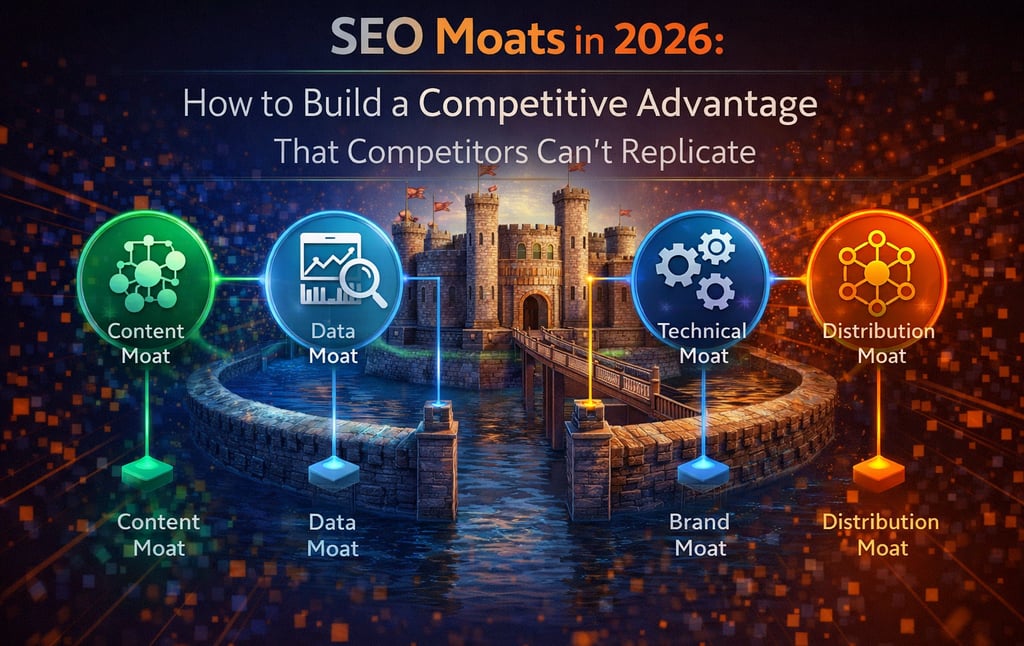
The Core Types of SEO Moats
Content Moat
A content moat is built through deep topical authority.
Instead of publishing isolated articles, you create structured content ecosystems:
Pillar pages
Supporting articles
Internal linking
Comprehensive topic coverage
Over time, your site becomes a trusted source within a subject.
This makes it difficult for competitors to outrank you with a single piece of content.
Data Moat
A data moat comes from unique information.
This could include:
Original research
Industry reports
Proprietary data
Tools or calculators
When your content includes insights that others don’t have, it becomes more valuable and more difficult to replicate.
Brand Moat
A brand moat is built when users actively search for your name.
Search engines recognize branded searches as strong authority signals.
When your brand is associated with a topic, your content gains an advantage across related queries.
Brand-driven SEO is one of the most powerful long-term assets.
Technical Moat
A technical moat comes from infrastructure and scalability.
Examples include:
Programmatic SEO systems
Strong internal linking architecture
Fast, optimized website performance
Structured data implementation
These elements improve efficiency and create advantages that are difficult for competitors to match quickly.
Distribution Moat
A distribution moat is built through visibility beyond your website.
This includes:
High-quality backlinks
Mentions across authoritative platforms
Partnerships and collaborations
Strong distribution increases trust and amplifies your reach, making your content more likely to rank and be referenced.
How AI Is Changing SEO Moats
AI has made content creation easier than ever.
This has increased competition.
As more businesses publish content at scale, basic SEO tactics are becoming less effective.
This makes moats more important.
In an AI-driven landscape, the advantage shifts from who creates content faster to who builds stronger systems and authority.
How to Build an SEO Moat
Building a moat requires a structured approach.
Start by choosing a clear niche where you can build authority.
Develop deep content coverage around that niche rather than spreading efforts across unrelated topics.
Create unique value through insights, data, or perspectives that others cannot easily replicate.
Strengthen your internal structure with strong linking and clear content organization.
Invest in brand building so that users begin associating your name with your expertise.
Over time, these elements combine to form a defensible position.
The Strategic Advantage
A strong SEO moat changes how your website performs.
Instead of chasing rankings, you begin to hold them.
Instead of reacting to competitors, you create a position they struggle to challenge.
Growth becomes more stable. Authority compounds. Results become more predictable.
Final Thoughts
SEO is no longer just about optimization.
It is about defensibility.
In 2026, the websites that dominate search are not the ones that publish the most content or build the most links.
They are the ones that build systems, authority, and brand strength that competitors cannot easily replicate.
Because in modern SEO, the real advantage is not just ranking higher.
It is making it difficult for anyone else to take your place.