
SEO Timeline in 2026: How Long Does It Really Take to See Results?
Discover the real SEO timeline—from initial setup to compounding results—and learn how to set the right expectations for success.
4/1/20262 min read
One of the most common questions in SEO is:
“How long will it take to see results?”
The honest answer is:
👉 It depends—but not in the way most people think.
In 2026, SEO is not slow. It is compounding. The problem is not the speed of SEO. It’s the expectations around it.
The Biggest SEO Myth
You’ve probably heard:
👉 “SEO takes 3–6 months.”
This is one of the most misleading statements in the industry.
Why?
Because SEO timelines are not fixed.
Some websites see early traction within weeks.
Others take months to gain momentum.
The real timeline depends on multiple factors—not a generic timeframe.
What Actually Impacts SEO Timeline
Several key elements determine how quickly you see results.
Competition
Highly competitive industries take longer because more authority is required to rank.
Website Authority
Established websites often see faster results than new or low-authority sites.
Content Quality
Well-structured, high-quality content performs faster than generic or thin content.
Strategy
A clear, system-driven approach accelerates results compared to random efforts.
Execution Consistency
SEO rewards consistency. Irregular efforts slow down progress significantly.
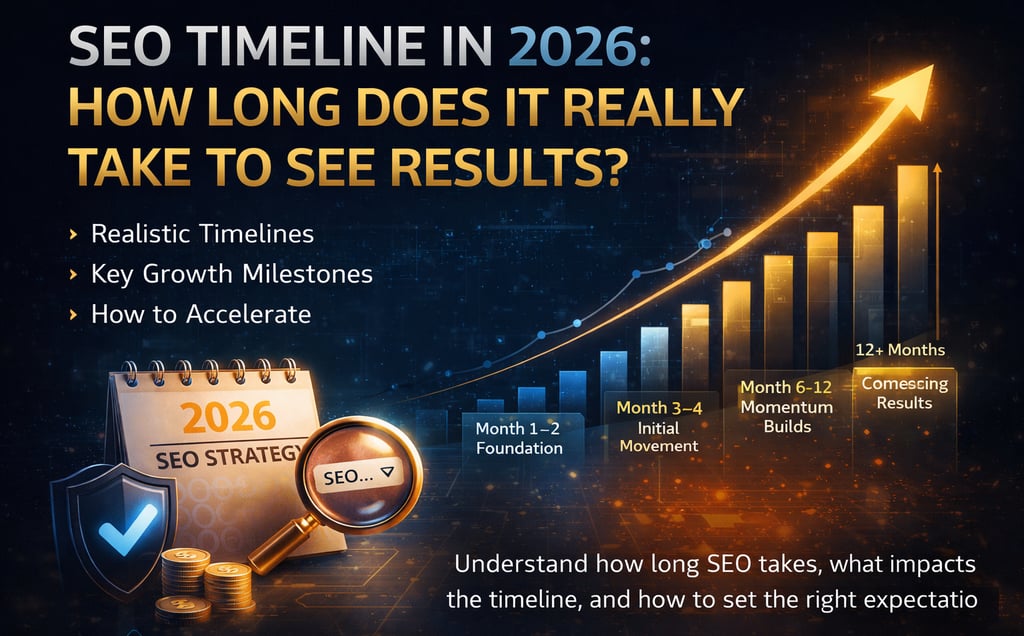
A Realistic SEO Timeline Breakdown
While timelines vary, here’s a practical way to understand how SEO typically progresses.
Month 1–2: Foundation
This phase focuses on:
Technical audit and fixes
Site structure improvements
Keyword and intent mapping
At this stage, you may not see major traffic changes—but the groundwork is being built.
Month 3–4: Content & Initial Movement
Content starts getting indexed
Early keyword rankings appear
Search engines begin understanding your site
You may start seeing small increases in visibility.
Month 5–6: Growth Begins
Traffic starts increasing
More keywords rank
Authority signals strengthen
This is where SEO begins to show measurable impact.
Month 6–12: Momentum Builds
Consistent traffic growth
Improved rankings for competitive keywords
Better conversion performance
SEO becomes a reliable growth channel.
12+ Months: Compounding Results
Strong authority established
High rankings across multiple topics
Lower acquisition cost over time
This is where SEO delivers its highest ROI.
Fast vs Slow SEO Scenarios
Not all SEO journeys are the same.
Faster Results
Low competition niches
Strong domain authority
Focused content strategy
Slower Results
Competitive industries
New websites
Lack of consistent execution
Understanding this helps set realistic expectations.
Why SEO Feels Slow (But Isn’t)
SEO often feels slow because results are not immediate. But unlike paid ads, SEO builds over time. Each piece of content, each backlink, and each improvement contributes to future growth. The impact compounds. What starts slow often becomes exponential.
How to Speed Up SEO Results
While SEO cannot be rushed, it can be optimized.
Focus on:
Creating high-quality, intent-driven content
Building strong authority through relevant backlinks
Maintaining consistent publishing
Structuring your website effectively
A well-executed strategy significantly improves timelines.
SEO vs Paid Ads Timeline
Understanding the difference helps set expectations. Paid ads deliver instant traffic—but require continuous spending. SEO takes time—but creates long-term value. The most effective approach is often a combination of both.
The Strategic Perspective
SEO is not about quick wins. It is about building a system that delivers sustainable growth. Businesses that understand this are more patient—and ultimately more successful.
Final Thoughts
SEO timelines are not fixed. They are influenced by strategy, execution, and consistency. In 2026, SEO is not slow. It is one of the most powerful long-term growth channels available. Because the real value of SEO is not how quickly it starts. It’s how strongly it scales.