
The AI-First SEO Framework: How Modern Search Strategy Is Being Rebuilt
SEO is being rebuilt. This guide explains how an AI-first framework turns reactive optimization into predictive, revenue-aligned growth.
2/25/20262 min read
SEO is not what it was five years ago.
Search engines are powered by artificial intelligence. Ranking systems evaluate intent, context, authority, structure, and behavior signals simultaneously. Static optimization checklists are no longer enough.
In 2026, the most effective SEO strategies aren’t reactive.
They are AI-first.
This doesn’t mean letting machines replace strategy. It means designing SEO systems around data, modeling, and intelligence from the start — not as an afterthought.
What “AI-First” Really Means
AI-first SEO is not about using AI tools to write content faster.
It means building your entire search strategy around:
Data-driven opportunity modeling
Predictive performance forecasting
Intent-based content mapping
Continuous technical monitoring
Authority engineering
Instead of asking, “What should we optimize next?”
You ask, “What does the data predict will create the highest impact?”
That shift changes everything.
Why Traditional SEO Is Becoming Obsolete
Traditional SEO often follows this pattern:
Research keywords.
Create content.
Build backlinks.
Wait for rankings.
The problem is fragmentation.
These actions operate in silos. Content teams work separately from technical teams. Reporting happens after results. Strategy adjusts only when something breaks.
In an AI-driven search ecosystem, this reactive model falls behind quickly.
Modern SEO must be integrated and predictive.
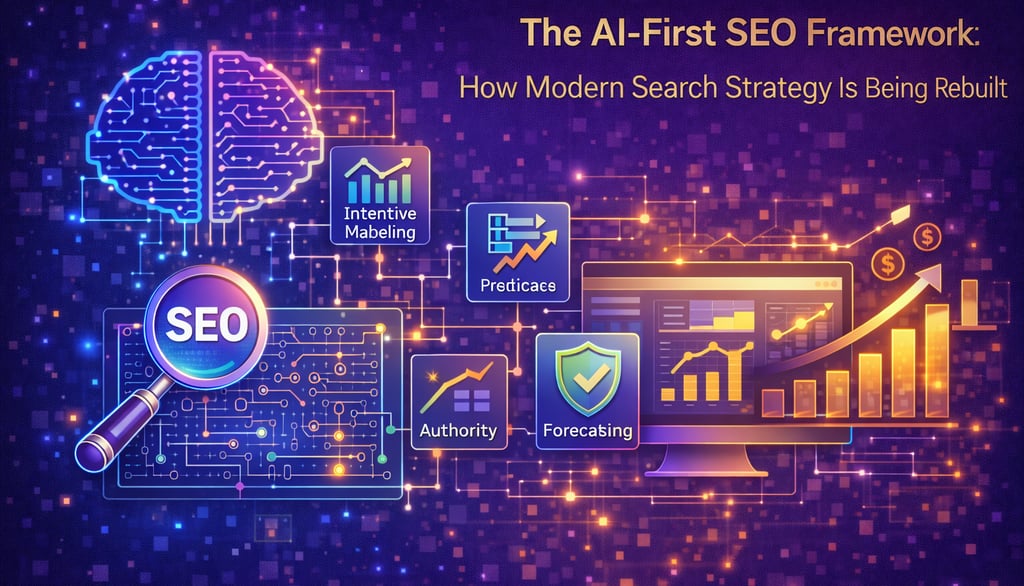
The Core Pillars of an AI-First SEO Framework
An AI-first framework unifies every component of search into one structured system.
Strategic Intent Mapping
Instead of targeting isolated keywords, you map full topic ecosystems. AI helps cluster search queries by intent and commercial value, ensuring content aligns with real demand.
This reduces wasted effort and improves conversion potential.
Predictive Content Engineering
Content is planned based on modeled opportunity, not assumptions.
AI systems analyze ranking probability, competitive depth, and authority gaps. Content creation becomes strategic expansion, not random publishing.
Every new page strengthens an existing structure.
Continuous Technical Optimization
Technical SEO is no longer a quarterly audit task.
AI-driven monitoring detects crawl inefficiencies, indexation shifts, and performance bottlenecks in real time. Instead of reacting to traffic drops, issues are addressed before impact spreads.
Stability becomes a competitive advantage.
Authority Engineering
Backlink acquisition shifts from volume-based tactics to contextual intelligence.
AI identifies authoritative, relevant sources aligned with your niche. Authority growth becomes structured and risk-managed rather than experimental.
Relevance replaces scale.
Revenue-Based Reporting & Forecasting
AI-first frameworks connect organic visibility directly to revenue modeling.
Forecasting systems estimate traffic growth, conversion probability, and long-term revenue contribution. SEO moves from “visibility metrics” to financial projections.
This is where predictability begins.
The Integration Advantage
The true strength of AI-first SEO is integration.
Content strategy supports authority building.
Technical optimization supports content visibility.
Forecasting informs content prioritization.
Reporting guides future expansion.
Nothing operates independently.
This system-based approach compounds growth over time.
AI-First vs Tool-Driven SEO
There’s a difference between using AI tools and being AI-first.
Tool-driven SEO adds automation to outdated processes.
AI-first SEO redesigns the process itself.
It replaces reactive execution with predictive modeling. It prioritizes structured growth over tactical wins. It connects search strategy directly to business objectives.
That structural shift is what separates leaders from laggards.
The Competitive Landscape in 2026
As more businesses adopt AI-powered search tools, competition increases.
The advantage no longer comes from access to technology. It comes from implementation strategy.
Businesses that build integrated systems will scale.
Those relying on disconnected tactics will struggle with volatility.
Final Thoughts
SEO is being rebuilt.
Search engines are smarter. Data is deeper. Competition is sharper.
An AI-first SEO framework doesn’t chase rankings. It engineers growth.
When strategy is predictive, integrated, and revenue-aligned, organic search becomes more than a marketing channel.
It becomes a long-term strategic asset.
Because in 2026, the future of SEO doesn’t belong to those who optimize faster.
It belongs to those who think smarter.