
The Complete SEO Strategy for 2026: AI, Content, Authority & Growth Systems
A complete guide to modern SEO—learn how technical foundations, content clusters, AI, and conversion strategies work together to drive sustainable growth.
3/23/20263 min read
SEO is no longer a collection of tactics.
It is a system.
For years, businesses approached SEO by optimizing keywords, publishing blog posts, and building backlinks. While these methods still matter, search engines have evolved. They now evaluate context, relationships, intent, and authority—not just individual pages.
In 2026, successful SEO is not about isolated actions.
It is about building a connected growth system.
This guide brings together everything modern SEO requires—from AI-driven search to content systems, authority building, and revenue optimization.
The Evolution of SEO
SEO has gone through several major shifts.
Initially, it focused on keyword matching. Pages ranked based on how well they matched search queries.
Then came link-based authority, where backlinks became a major ranking factor.
Today, search engines operate differently. They analyze:
Entities and relationships
User intent
Content depth
Brand signals
Behavioral data
Search is no longer about finding pages.
It is about understanding information.
This shift requires a more structured and strategic approach.
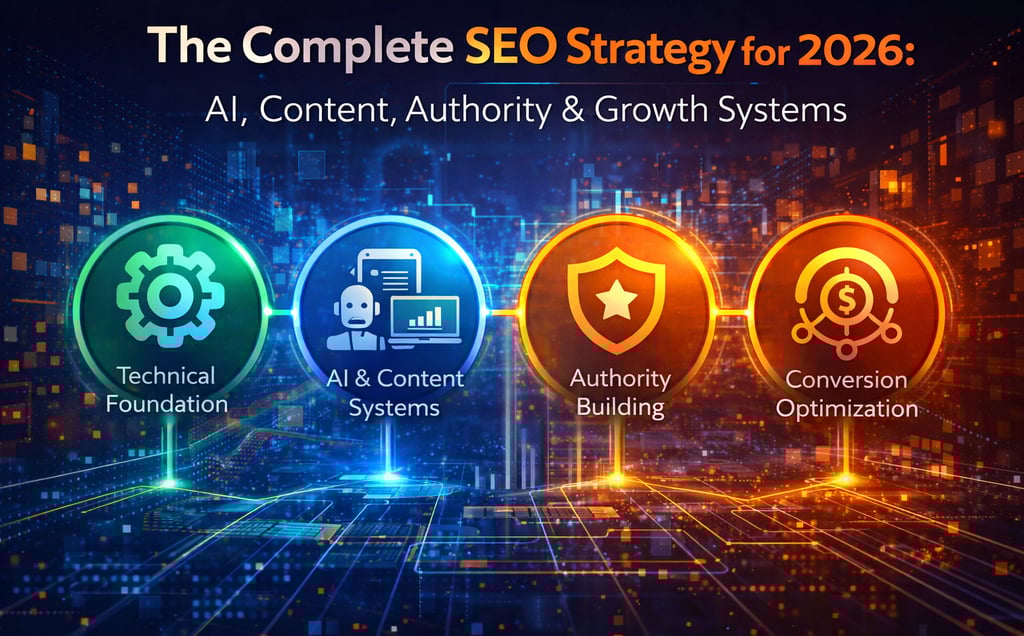
The Five Core Pillars of Modern SEO
Modern SEO is built on five interconnected pillars.
1. Technical Foundation
Every SEO strategy starts with a strong technical base.
Search engines must be able to crawl, index, and understand your website efficiently.
Key elements include:
Fast loading speeds
Mobile optimization
Clean site architecture
Proper indexing and crawlability
Without a solid technical foundation, even the best content may struggle to perform.
2. Content Systems
Content is no longer about publishing individual articles.
It is about building content ecosystems.
This includes:
Pillar pages covering core topics
Supporting articles exploring subtopics
Internal linking that connects everything
Content systems help search engines understand your expertise within a subject.
They also improve user experience by guiding visitors through related topics.
3. Authority Building
Authority determines whether your content is trusted.
Search engines evaluate authority through:
Backlinks from credible sources
Brand mentions
Entity recognition
Consistent topical coverage
Building authority is not just about links.
It is about becoming a recognized source within your industry.
4. Conversion Optimization
Traffic alone does not drive growth.
SEO must lead to measurable outcomes.
Conversion optimization focuses on:
Aligning content with user intent
Clear calls to action
Strong user experience
Trust-building elements
This ensures that visitors take meaningful actions after arriving on your site.
5. Analytics and Forecasting
Modern SEO is data-driven.
Businesses must track performance and predict outcomes.
This includes:
Measuring conversions and revenue
Analyzing page-level performance
Identifying growth opportunities
Forecasting future traffic and results
Analytics transforms SEO from guesswork into a strategic growth channel.
How AI Is Reshaping SEO
AI is one of the most significant forces in modern search.
Search engines now use AI to:
Interpret user intent
Generate answers
Understand content relationships
Evaluate authority signals
AI has also changed content creation.
While it enables faster production, it has increased competition.
This makes quality, structure, and differentiation more important than ever.
AI does not replace SEO.
It raises the standard.
Building an SEO Growth System
The most effective SEO strategies connect all elements into a single system.
Content attracts users.
Internal linking builds structure.
Authority signals increase trust.
Traffic grows.
Conversions turn that traffic into revenue.
Each component supports the others.
When aligned correctly, this creates a cycle of continuous growth.
Instead of chasing rankings, you build a system that generates them.
Common SEO Mistakes to Avoid
Even with advanced strategies, certain mistakes can limit performance.
One common issue is focusing only on keywords without understanding intent.
Another is producing content without structure, leading to weak topical authority.
Some businesses prioritize traffic over conversions, missing the true goal of SEO.
Others neglect technical optimization, which limits visibility.
Avoiding these mistakes helps create a more stable and effective strategy.
The Future of SEO
SEO will continue evolving toward:
AI-driven search experiences
Zero-click results and answer engines
Entity-based understanding
Brand-driven rankings
Search engines will increasingly prioritize trusted sources that provide clear, structured, and valuable information.
This means long-term success depends on building authority—not just optimizing pages.
Final Thoughts
SEO in 2026 is no longer about individual tactics.
It is about systems.
Websites that succeed combine:
Strong technical foundations
Structured content ecosystems
Authority-building strategies
Conversion optimization
Data-driven decision-making
Together, these elements create a powerful and sustainable growth engine.
Because the future of SEO is not about ranking for more keywords.
It is about building a system that continuously drives visibility, trust, and revenue.