
Topical Authority in 2026: Why Google Rewards Depth Over Volume
Learn why Google rewards topical authority over content volume in 2026 — and how building structured, in-depth topic clusters drives stronger, more stable rankings.
2/16/20262 min read
Publishing more content no longer guarantees better rankings.
In 2026, search engines are far more sophisticated. They don’t just evaluate individual pages — they evaluate expertise across entire topics.
This is where topical authority becomes the difference between websites that rank occasionally and those that dominate consistently.
If your SEO strategy is still focused on producing isolated blog posts, you’re competing at a disadvantage.
What Is Topical Authority?
Topical authority is the level of trust and expertise your website demonstrates within a specific subject area.
Instead of ranking because one article is well optimized, you rank because your entire website signals depth, structure, and subject mastery.
Search engines now evaluate:
How comprehensively you cover a topic
How your pages connect to one another
Whether your content demonstrates real expertise
How users engage with your ecosystem of information
Authority is no longer built page by page. It’s built topic by topic.
Why Volume Alone Doesn’t Work Anymore
There was a time when publishing more articles meant more traffic opportunities.
That approach now creates diluted authority.
If your website covers dozens of loosely related topics without depth, search engines struggle to categorize your expertise. The result? Inconsistent rankings and fragile visibility.
Depth creates clarity.
Clarity creates trust.
Trust drives rankings.
How Google Evaluates Depth
Modern search systems analyze relationships between pages.
They look at:
Semantic connections between articles
Internal linking structure
Breadth of coverage within a niche
Consistency of subject focus
If your website covers AI-powered SEO from strategy to audits to revenue alignment — and those pieces are interconnected — it signals true expertise.
Scattered content does not.
The Shift From Keywords to Topics
Traditional SEO targeted individual keywords.
Modern SEO builds topic ecosystems.
Instead of writing one article about “technical SEO,” you build:
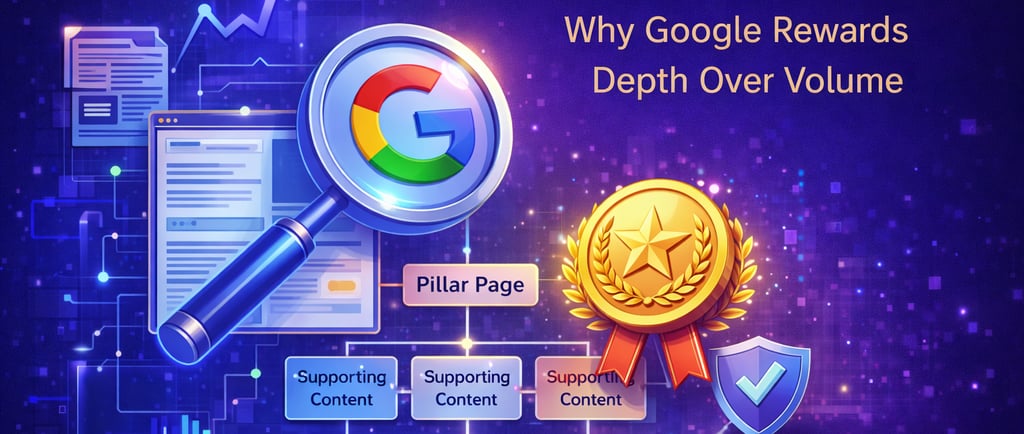
A pillar page explaining the concept
Supporting articles diving into specific components
Internal links that reinforce hierarchy
Structured navigation that guides users and crawlers
This approach compounds authority over time.
How to Build Topical Authority in 2026
Start by narrowing your core focus. Define the themes your business truly owns.
Then build structured content around those themes. Each new article should strengthen an existing topic cluster — not create a disconnected branch.
Interlink strategically. Internal linking is not just navigation; it’s a signal of importance and relationship.
Finally, update and expand existing content regularly. Authority grows through refinement, not just expansion.
Where AI Changes the Game
AI-powered analysis makes it easier to identify:
Content gaps within a topic
Overlapping or cannibalized pages
Emerging subtopics gaining traction
Structural weaknesses in clusters
Instead of guessing what to publish next, you build authority methodically.
AI doesn’t replace expertise — it accelerates structured growth.
The Competitive Advantage
Businesses that build topical authority benefit from:
More stable rankings
Higher trust from users
Greater visibility across related queries
Increased conversion potential
When your website becomes a recognized resource within a niche, rankings become less volatile.
That stability creates predictable growth.
Final Thoughts
In 2026, SEO is no longer about publishing more.
It’s about publishing smarter.
Topical authority rewards businesses that go deep, stay focused, and structure their content intentionally.
If you want sustainable rankings, stronger trust, and scalable organic growth, build authority — not just articles.
Because search engines don’t reward noise.
They reward expertise.