
Why Most SEO Strategies Fail in 2026 (And How to Fix Them)
Discover why outdated SEO tactics no longer drive consistent growth — and how integrated, revenue-aligned strategy creates scalable results.
3/2/20262 min read
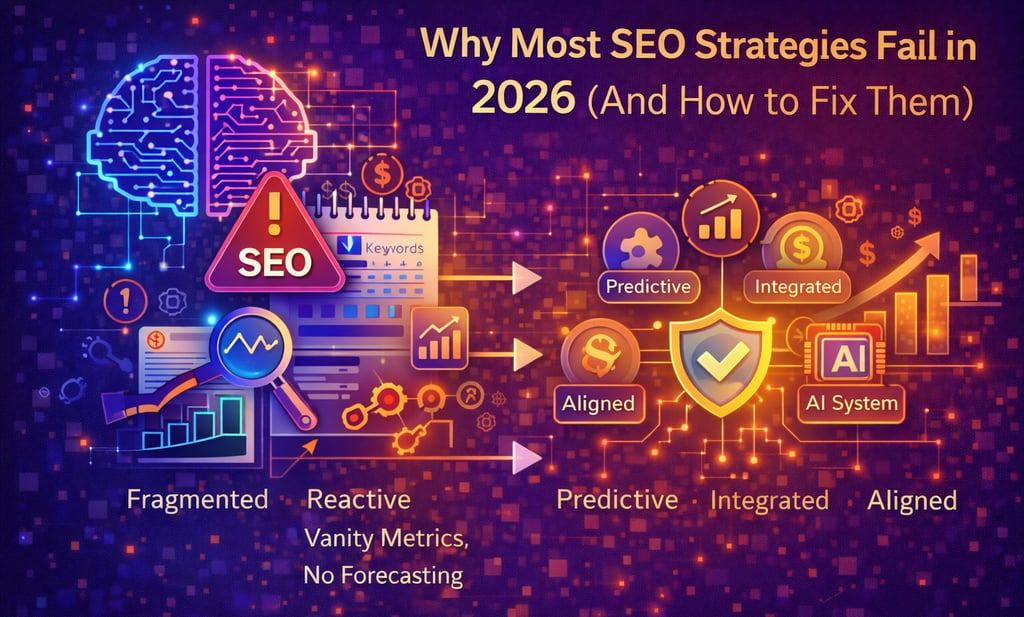
SEO hasn’t become harder.
It has become smarter.
Yet most strategies still operate like it’s 2018.
Businesses invest in content. They build backlinks. They monitor rankings. And still — growth stalls, traffic fluctuates, and revenue impact remains inconsistent.
The issue isn’t effort.
It’s structure.
In 2026, SEO fails not because it doesn’t work — but because most strategies are outdated.
Failure #1: Reactive Instead of Predictive
Many SEO campaigns react to problems.
Traffic drops? Run an audit.
Rankings decline? Build more links.
Competitor publishes content? Publish more.
This approach creates constant motion without strategic direction.
Modern SEO requires forecasting, modeling, and intent mapping before execution begins.
If you’re not predicting growth scenarios, you’re guessing.
And guessing doesn’t scale.
Failure #2: Fragmented Execution
Content teams operate separately from technical teams.
Link-building happens independently of content strategy.
Reporting is disconnected from revenue metrics.
This siloed structure weakens results.
In 2026, SEO must function as an integrated system:
Technical clarity supports content visibility.
Content depth supports authority growth.
Authority supports ranking stability.
Forecasting supports prioritization.
When these elements operate independently, performance becomes unstable.
Failure #3: Obsession With Vanity Metrics
Many businesses still measure SEO success by:
Keyword rankings
Traffic volume
Impressions
While these metrics provide insight, they don’t measure business impact.
High traffic with low conversion is not growth.
Modern SEO must connect directly to:
Conversion rates
Lead quality
Revenue contribution
Lifetime value impact
Without that alignment, SEO becomes activity — not strategy.
Failure #4: Ignoring Intent Depth
Publishing content without mapping search intent is one of the fastest ways to dilute authority.
In 2026, search engines evaluate context and semantic relationships at scale.
If your content:
Overlaps internally
Targets shallow keywords
Lacks structured hierarchy
You weaken topical authority.
Winning strategies build ecosystems — not isolated blog posts.
Failure #5: Underestimating AI-Driven Search
Search engines now synthesize information, interpret entities, and generate answers.
If your strategy is still optimized only for blue links, you’re already behind.
Generative search systems reward:
Structured authority
Entity clarity
Topical depth
Trust signals
Surface-level optimization is no longer sufficient.
Failure #6: No Long-Term Model
Many SEO campaigns lack a growth framework.
There’s no projection model.
No scenario planning.
No revenue forecasting.
Without modeling, businesses lose confidence during volatility.
But volatility without structure creates panic.
Structure creates predictability.
How to Fix It
The solution isn’t more content.
It isn’t more backlinks.
It isn’t more tools.
It’s rebuilding SEO as a structured, AI-first system.
That means:
Modeling growth before execution
Mapping intent across the full funnel
Integrating technical, content, and authority strategy
Monitoring continuously instead of periodically
Aligning reporting with revenue
When SEO becomes a system instead of a collection of tactics, stability increases.
And stability compounds growth.
The Strategic Shift
In 2026, SEO belongs to businesses that think beyond tasks.
Beyond rankings.
Beyond traffic spikes.
Beyond short-term wins.
The brands that win build structured, predictive, integrated systems aligned with business objectives.
Everyone else keeps reacting.
Final Thoughts
SEO strategies fail when they remain tactical.
They succeed when they become architectural.
If your organic growth feels inconsistent, it’s not because SEO doesn’t work.
It’s because your structure doesn’t support scale.
Fix the structure — and the growth follows.